
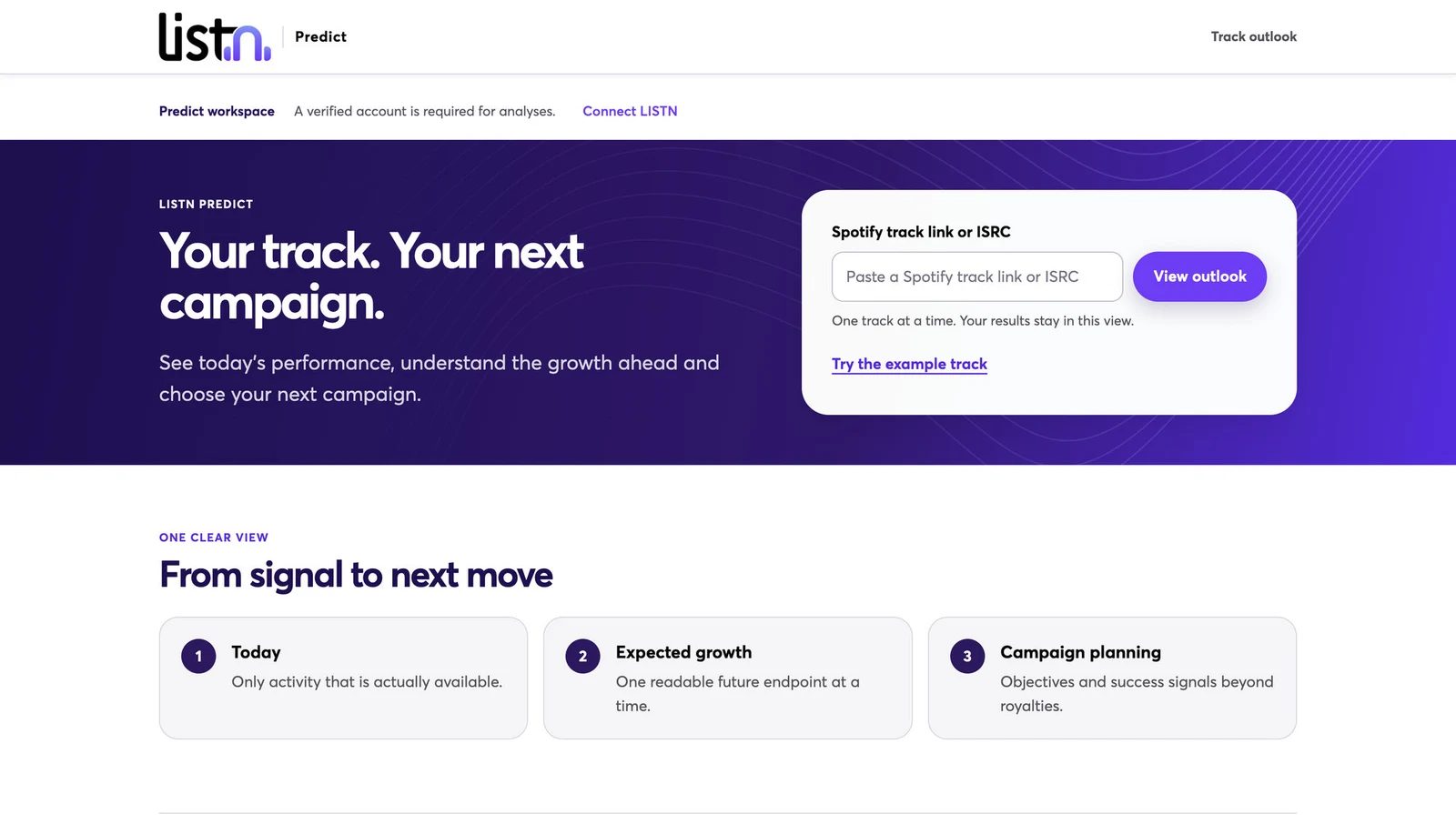
The new LISTN Predict brings track analysis, growth estimates and campaign planning into one workflow. Start with a Spotify track link or ISRC, review the activity available today, explore the expected growth and prepare the next promotion decision. The interface is organized around three steps: Today, Expected growth and Campaign planning.
For artists and labels, the practical question is rarely just “How many streams does this song have?” It is “What should we do next?” Predict gives that decision a structure, while keeping recorded activity, forecasts and campaign scenarios separate.
Explore the new LISTN Predict. Connect a verified LISTN account when prompted and check the analysis allowance shown in your workspace.
What is new in LISTN Predict?
The new experience follows the decision from evidence to action. Instead of asking you to interpret a collection of disconnected indicators, it groups the track outlook into three readable sections.
- Today: available platform activity, detected radio airplay and dated observations.
- Expected growth: Spotify stream estimates at selectable horizons, with lower, expected and higher estimates when available.
- Campaign planning: a recommended direction, an editable budget and a route to saving a campaign draft for review.
The interface also includes an Export PDF option for sharing an available analysis. The aim is a release discussion that can move from “What do we know?” to “What do we test?” without confusing a planning estimate with a result already achieved.
1. Understand the track’s current performance
The Today section starts with the activity that is actually available. This is the baseline for the rest of the analysis: what has been recorded, which unit it uses and when it was observed.
Radio visibility has its own area, including a station-level view with country and airplay information when detected. The recorded-growth section uses dated observations. A history needs at least two dated observations before it can show how the track changed over time; an empty history is not evidence of zero growth.
Keeping the units separate is important. A stream, a short-form view, a creation and an airplay detection describe different things. Adding them together into one audience total would make the number bigger without making it more useful.
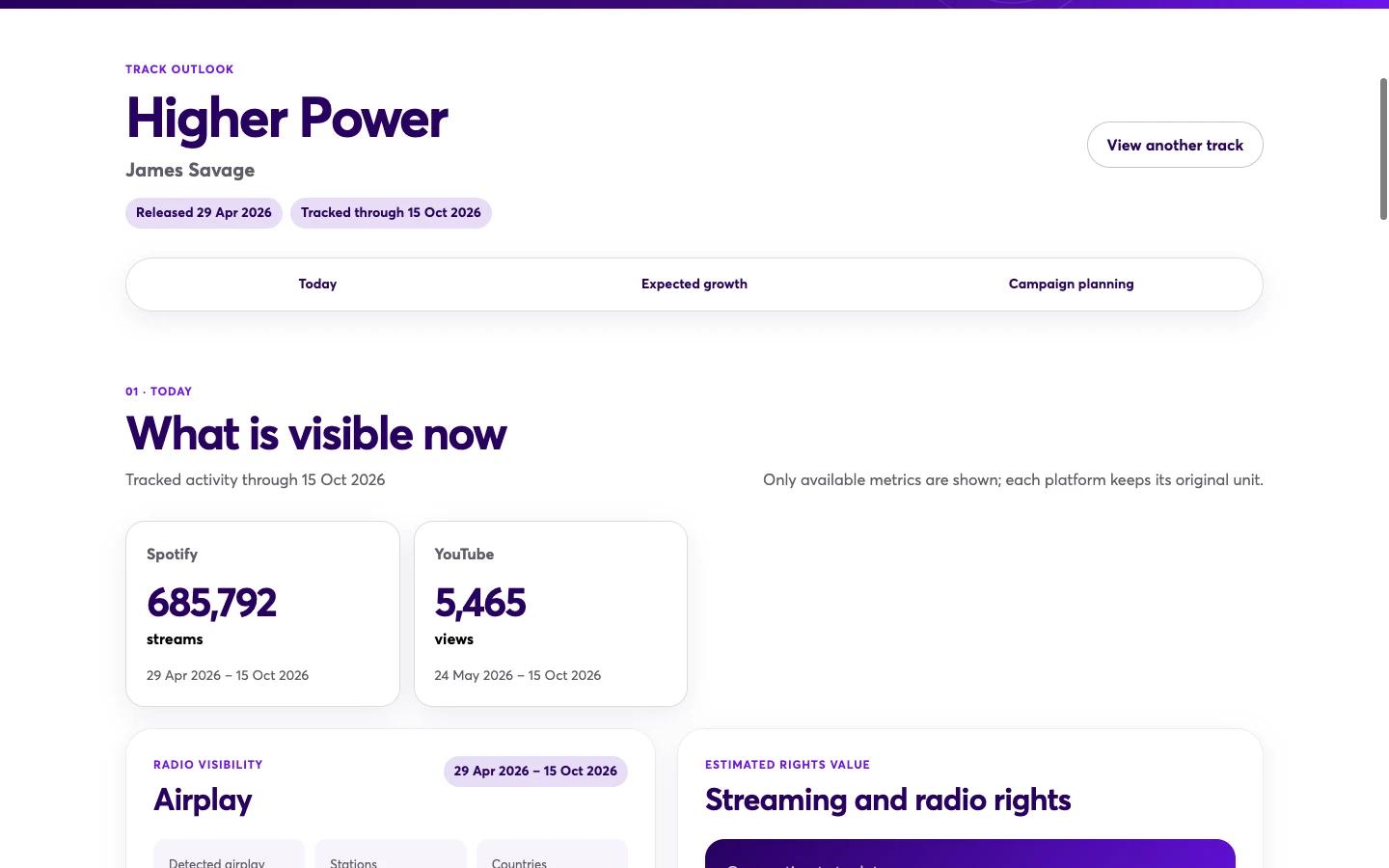
The Today view for an example track, captured October 15, 2026. The dated figures describe that recording, not an expected result for another release.
Start your review by checking the exact recording and the freshness of its observations. If the evidence is incomplete, note what you still need rather than filling the gap with an assumption.
2. Read a Spotify stream forecast without false precision
The Expected growth section lets you choose how far ahead to look. The dashboard distinguishes the recorded total today from the expected total at the selected horizon, and separates expected new streams from the cumulative total.
Where supported, it shows a lower estimate, an expected estimate and a higher estimate. These are planning estimates, not three outcomes you can choose or a promise that the future must stay inside a displayed range. The interface also offers a comparison of its five forecast horizons.
Consider a hypothetical example: a track has 100,000 recorded streams today and an expected total of 125,000 at a future horizon. That means 25,000 expected new streams, not 125,000 additional streams. These numbers illustrate how to read a cumulative forecast; they are not a LISTN forecast for a particular recording.
Use the forecast to frame questions about timing and scale. It can help a team discuss whether to support existing momentum or plan a discovery test. It should not become a guarantee in an artist report or a reason to spend without reviewing the assumptions.
What do estimated rights values mean?
Predict labels rights values as gross estimates. They are not cash received or the artist’s take-home income. Contract splits, deductions, tax and collection timing are not included in that figure.
Keep a streaming or radio rights estimate separate from a campaign’s broader purpose. Discovery, artist image, saves, repeat listening and fan growth can matter even when direct royalties do not cover the promotion budget. An estimate is useful context; it is not a complete investment case.
3. Turn the analysis into a campaign plan
The Campaign planning section connects the outlook to a potential next move. It includes a recommended direction, campaign options, an editable budget, explanations of the choice and success signals to review.
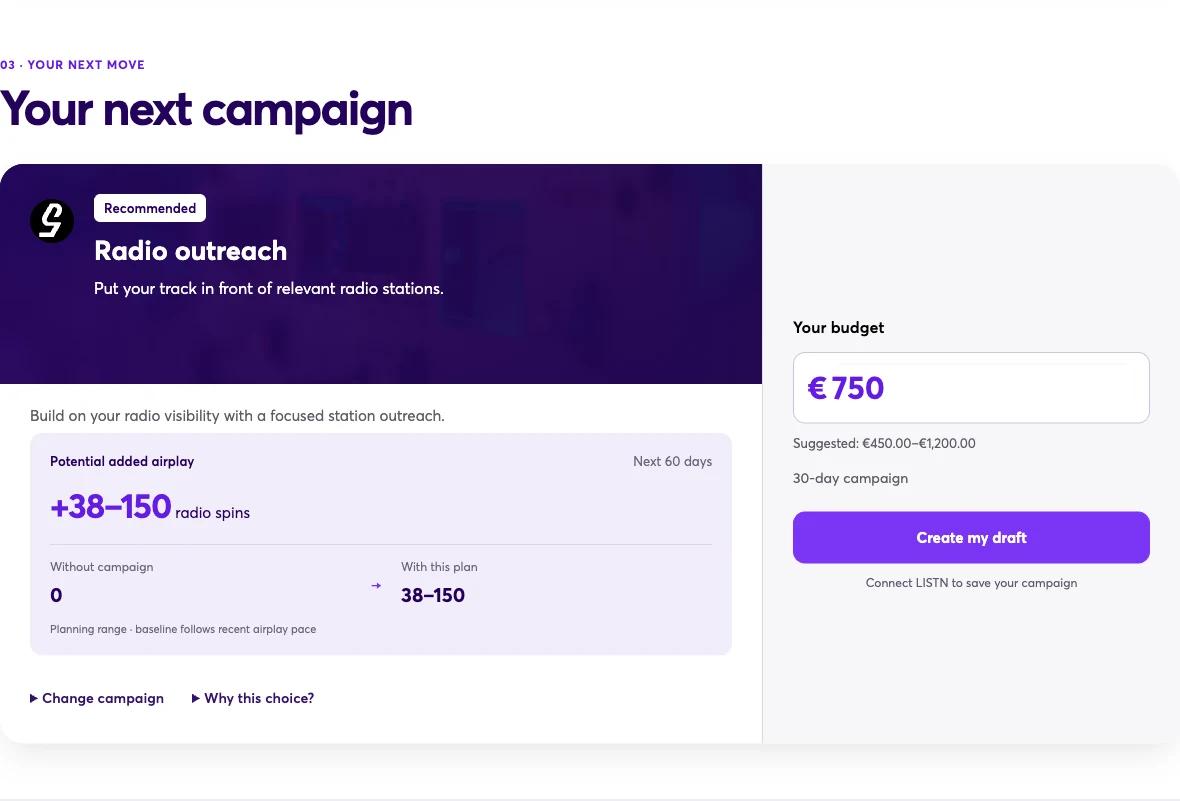
A radio-outreach planning example, captured October 15, 2026. The airplay range is a scenario estimate, not a guaranteed campaign outcome.
A campaign scenario should stay in its own unit. For a radio plan, potential added airplay is different from additional Spotify streams. A before-and-after planning comparison is also different from evidence that the campaign has already produced an incremental result.
Before accepting a recommendation, ask three practical questions:
- What is the objective? Define the discovery or audience behavior you want to change.
- What will this budget test? Keep the initial plan small enough to review before scaling.
- What result would change the next decision? Set a review point and choose the relevant metric in advance.
Use the music promotion budget guide to place that test inside your wider release spend. If the plan involves a coordinated short-form activation, the LISTN Creator Contest guide explains that separate service and its budget.
Save a draft, then review it in LISTN
Predict includes a Create my draft workflow linked to your LISTN account. The connection step is separate from simply entering the track identifier. Once a draft is saved, the interface directs you back to LISTN to review the next details.
A saved draft is not a paid or launched campaign. Confirm the price, countries, start date and required assets before launch. This keeps the handoff useful: the analysis informs the plan, and the campaign owner still reviews the actual commitment.
How to start your first track outlook
- Open LISTN Predict and connect a verified account when requested.
- Paste the exact Spotify track link or ISRC.
- Review current observations before reading future estimates.
- Compare the relevant forecast horizon and its available range.
- Explore a campaign direction, adjust the budget and save a draft if appropriate.
- Review the saved campaign in LISTN before confirming payment or launch.
If an analysis is unavailable, retry later or check the account and allowance shown in the workspace. Do not interpret an unavailable outlook as a negative assessment of the music.
Frequently asked questions
Can I analyze a track using its ISRC?
Yes. The current input accepts a Spotify track link or ISRC. Use the identifier for the exact recording you want to evaluate.
Do I need to sign in?
The current workspace states that a verified account is required for analyses. Follow the connection prompt and check the allowance displayed for your account.
Does Predict guarantee future streams or campaign ROI?
No. Forecasts and campaign scenarios are estimates. They do not guarantee streams, airplay, royalties or a financial return.
Can I share the analysis?
The new interface includes Export PDF. Keep estimate labels and the analysis context attached when sharing results with an artist or team.
Can I work conversationally instead?
LISTN MCP offers a conversational route to track analysis and promotion strategy through compatible AI assistants. Predict provides the dedicated visual workflow.
Make the next campaign a clearer decision
Start with one recording and one question about its next move. Use the current evidence, read the estimates in context and prepare a campaign you can review before spending.