
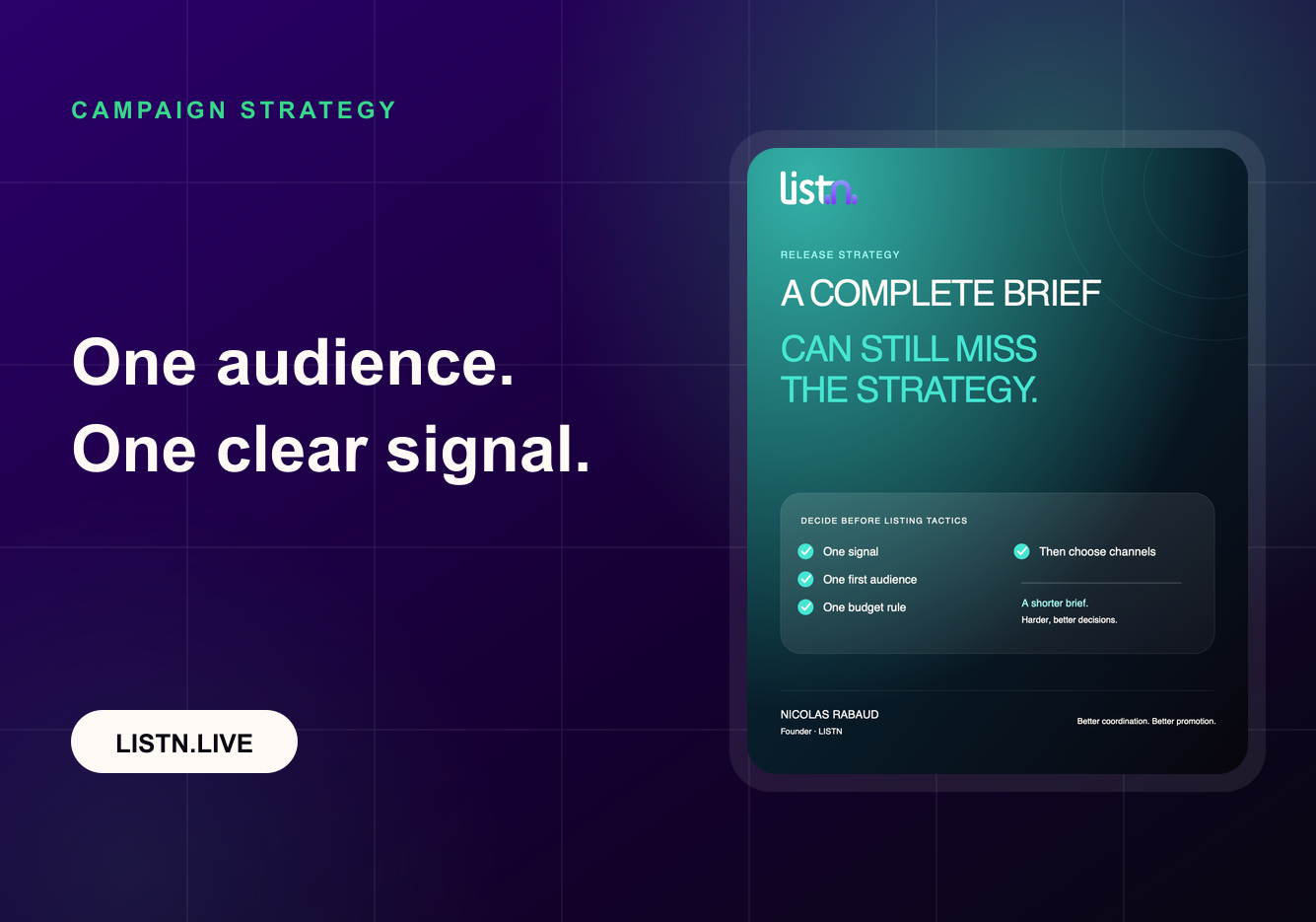
A useful music campaign brief needs three decisions before it needs a list of channels: the signal the release must create, the audience that should react first and the evidence that will unlock more budget. Without those decisions, playlists, creators, radio, ads, content and PR become activity rather than strategy.
This template helps artists, managers and independent labels write a brief that can guide setup, reporting and the next budget decision. It is designed to remain short enough for a team to use every week.
The campaign brief in one page
- Release: exact track, version, artist, release date and public links.
- Objective: the business or audience problem the campaign should address.
- Primary audience: the first listener group, territory and context.
- Primary signal: the behavior that would show useful movement.
- Channel hypothesis: why one channel can create that signal.
- Test design: audience, creative, budget, timing and control variables.
- Decision rule: what the team will keep, stop or scale.
- Review dates: when evidence will be read and by whom.
1. Start with the release facts
The brief should identify the exact recording. Include the final title, version, artist, release date, territories, genre, language, master and public destinations. Add known constraints such as clean-edit requirements, rights limitations, creator usage rules or a territory that cannot be activated.
This section is factual. It prevents the campaign team from building a strategy around the wrong edit, incomplete rights or a link that belongs to another recording.
2. Write one objective
An objective describes what the release needs, not what the team plans to buy. “Run a playlist campaign” is a tactic. “Test whether the track creates qualified listening among melodic-house audiences in Germany” is an objective.
A release may eventually pursue several objectives, but the first test should have one priority. That keeps the campaign interpretable when results arrive.
3. Define the first audience
Specify the audience using the dimensions that matter for the decision: genre or scene, territory, listener relationship, creator community, radio format or playlist context. Avoid audiences so broad that every response looks relevant after the fact.
Weak audience definition
Electronic music fans worldwide.
Stronger audience definition
Listeners in France and Belgium who actively engage with melodic house and adjacent independent artists, with an initial emphasis on relevant playlist and creator contexts.
4. Choose a behavioral signal
Reach, impressions and views describe exposure. They do not automatically show that the release created intent. Select a signal connected to the job of the campaign: saves, repeat streams, artist follows, playlist adds, relevant replies, approved creator content, station interest or another verified action.
Write down how the signal will be measured and which limitations apply. If the team cannot observe downstream streaming behavior at campaign level, do not pretend that a placement caused a specific result. Use the evidence that can be verified.
5. Form a channel hypothesis
The brief should explain why the selected channel can produce the desired behavior for this track. Playlists can place music inside a listening context. Radio can test programming fit and repeated exposure. Creators can give a sound a native cultural or visual context. Paid media can run controlled message and audience tests.
Use the LISTN channel-selection framework when the team needs to compare radio, playlists and creators without treating placements as guaranteed outcomes.
6. Design the smallest useful test
A small budget spread across too many audiences, creatives and channels can produce several weak answers. Start with enough focus to learn something.
- One primary audience.
- One channel hypothesis.
- Two creative or message variations when the channel supports them.
- One primary signal.
- A fixed review point and a written scale rule.
The exact budget depends on the channel, territory and release priority. The principle is stable: the first test should be large enough to observe but narrow enough to interpret.
7. Write the budget rule before results arrive
Internal pressure is strongest around priority releases. A prewritten rule protects the team from scaling because a project feels important or stopping because one early number looks disappointing.
Example keep, stop or scale rule
- Keep the audience and creative combination that produces the strongest qualified response.
- Stop combinations that create inexpensive attention without the intended behavior.
- Scale only when the signal remains relevant as spend or volume increases.
Priority can determine the size of the initial test. Evidence should determine the next allocation.
8. Make reporting part of the brief
The report should not be designed after the campaign ends. Define the first screen before launch: objective, test, qualified signal, cost, learning and next decision. Supporting metrics can sit below that hierarchy.
For a label roster, campaign learning has value beyond the current release. Record which audience, creative, territory and channel produced the response so the next brief begins with evidence rather than memory.
Copy-and-use music campaign brief template
- Release: [track, version, artist, date, links].
- Objective: [the release problem this campaign should address].
- Primary audience: [listener relationship, genre, territory and context].
- Primary signal: [the behavior that would indicate useful movement].
- Channel hypothesis: [why this channel can create that signal].
- Test: [audience, two creative options, timing and budget].
- Constraints: [rights, assets, territories, claims and dependencies].
- Review: [D+3, D+7 or another defined point, plus the owner].
- Decision rule: [keep, stop or scale criteria].
Example brief
Objective: test whether a new electronic release can create intentional listening among adjacent genre audiences in France. Audience: active artist listeners plus listeners of comparable melodic-house artists. Signal: saves and repeat listening where available, supported by relevant campaign responses. Channel hypothesis: targeted playlists can place the track in a qualified listening context. Test: one audience definition, two pitch angles and a fixed first budget. Decision rule: scale only if response relevance and downstream listener signals remain stronger than the baseline.
Common briefing mistakes
- Listing channels before defining the release objective.
- Using “awareness” without naming the audience or next behavior.
- Changing the success metric after seeing the results.
- Splitting the first budget across too many variables.
- Reporting every metric with equal visual weight.
- Treating a placement, post or spin as a guaranteed listener outcome.
Use the brief to improve the next campaign
The best brief is not the longest document. It is the shortest document that makes the campaign decisions explicit and leaves enough evidence for the next release. Keep the release facts stable, make the hypothesis testable and schedule the decision before launch.
To turn the brief into a targeted campaign, explore LISTN and compare the available radio, playlist and creator workflows.
Sources and review date
This template was adapted from LISTN social publications released from August 10 to August 14, 2026, and reviewed on August 19, 2026. It reflects LISTN campaign-planning and reporting principles; it does not promise placements or streaming results.