
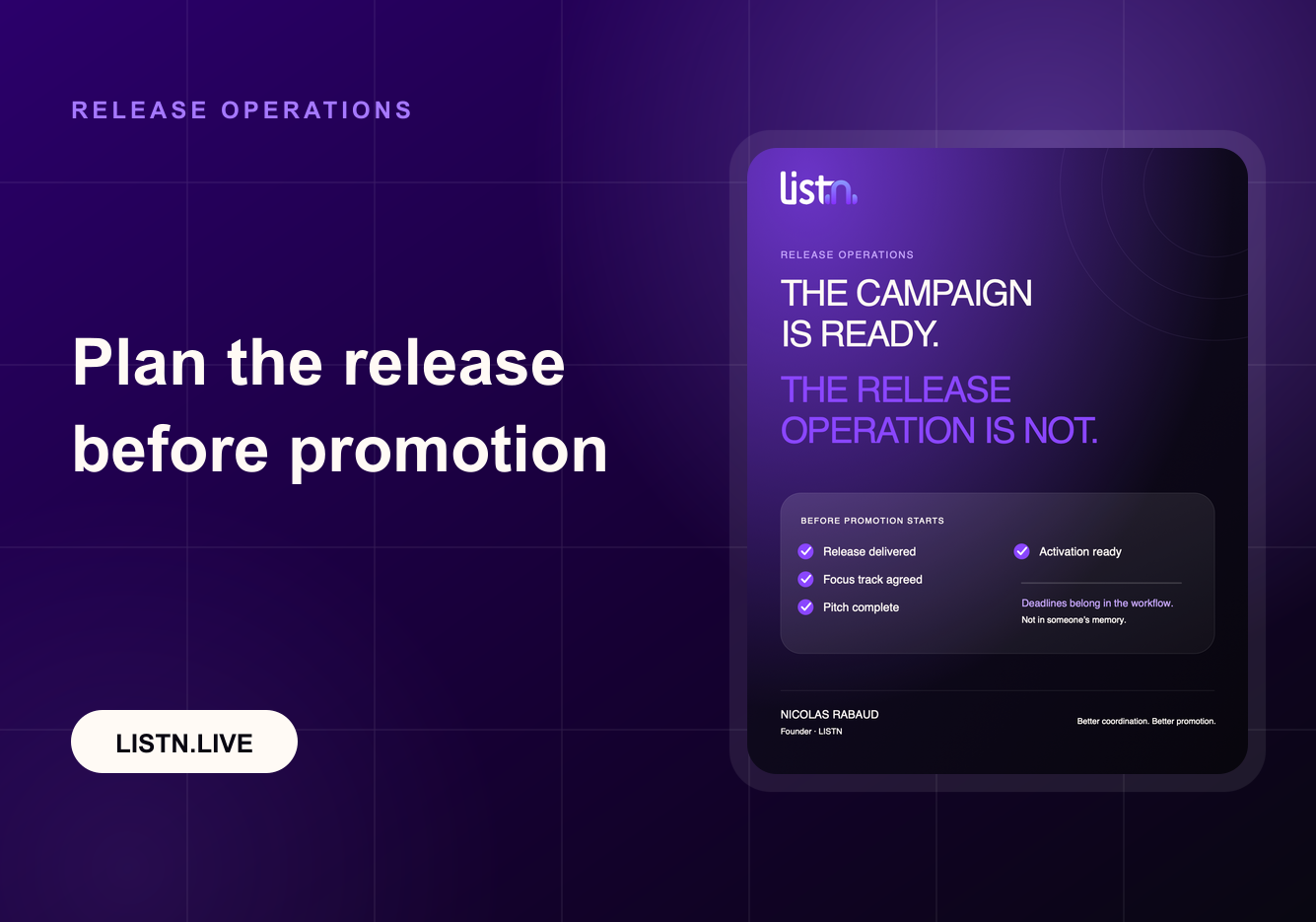
A strong music-promotion campaign cannot recover a release that arrived late, with the wrong master, incomplete metadata or no agreed focus track. The practical solution is a release workflow that assigns every pre-release decision to an owner and turns critical dates into shared checkpoints.
This checklist gives independent artists, managers and labels a seven-step system for moving from delivery to release day. It includes Spotify editorial pitching, asset preparation, audience definition and the handoff into post-release promotion.
Why release planning is a promotion issue
Promotion is often treated as the final layer added after distribution. In practice, campaign options are shaped much earlier. A late delivery can remove time for quality control. An undecided focus track can delay the Spotify pitch. Missing sound links can slow creator activity. An unclear owner can leave every task technically assigned to the team but completed by nobody.
The goal is not to predict every campaign result before release. It is to make sure the music, message, assets and measurement plan are ready when listeners can finally act.
1. Lock the exact release and focus track
Confirm the recording, title, artist name, featured artists, version and release date. If an EP or album contains several tracks, choose the focus track before campaign assets and pitches are finalized. The same recording identity should appear in the distributor delivery, artwork, Spotify pitch, social sounds and campaign brief.
- Use the approved master, not a near-final export.
- Make remix, radio edit, clean and instrumental versions unambiguous.
- Record who can approve a last-minute change and when changes stop.
2. Deliver early enough for platform checks
Your distributor needs time to deliver the release and resolve metadata or rights issues. Build a buffer before any platform deadline. A delivery confirmation is more useful than an assumed date, so verify that the upcoming release appears correctly in the relevant artist tools.
Spotify tells artists to deliver and pitch music at least seven days before release. A pitch submitted within that window can place the selected song in followers' Release Radar, but Spotify explicitly states that editorial placement is not guaranteed.
3. Complete the Spotify editorial pitch
Treat the pitch as a concise editorial brief. Describe the sound accurately, select relevant genres and moods, explain the release context and include the marketing plan that is actually confirmed. Avoid inflated claims and generic adjectives. Editors need usable context, not a press release.
Only unreleased music is eligible, and Spotify allows one song to be pitched at a time. Assign an owner to the pitch, then record the submission date so the team does not rely on memory.
4. Build one campaign-ready asset folder
The campaign operator should not have to search old messages for the latest artwork or audio. Create one reviewed folder containing the approved master, artwork, press images, short biography, credits, lyrics when relevant, clean edit, campaign copy and public links as they become available.
For short-form activity, prepare the creative system rather than one isolated clip: the full visual idea, several hooks, vertical edits, captions, subtitles and the intended platform sound. For radio, confirm the correct WAV and metadata. For playlists, prepare an accurate genre, mood and audience description.
5. Define the first audience and the signal
A campaign brief becomes useful when it states who should react first and what behavior would count as progress. “Reach more people” is not specific enough. A better objective might be to generate saves and repeat listening among electronic-music listeners in France, or to test radio interest in two priority territories.
Choose one primary signal for the first review. Supporting metrics can add context, but they should not compete with the main decision.
6. Assign owners and handoff dates
- Distribution owner: confirms delivery and platform ingestion.
- Release owner: approves the focus track, metadata and final assets.
- Campaign owner: defines audience, channels, budget and measurement.
- Content owner: prepares and approves creative variations.
- Reporting owner: reads the first signal and recommends the next action.
One person may hold several roles on a small team. The important point is that each responsibility has a name and a date.
7. Prepare release-day and post-release activation
Release day is the first point at which the public track link, real listener behavior and most promotional workflows can operate together. Confirm the live links, check that artist profiles and credits are correct, update campaign destinations and begin the approved post-release activity.
Choose channels by objective rather than habit. Our radio vs playlist vs creator promotion guide explains what each channel can test and how to compare the resulting evidence.
A practical timeline
Three to four weeks before release
Finalize the master, metadata, artwork, focus track and delivery. Start the asset folder and campaign brief.
At least seven days before release
Verify platform ingestion, complete the Spotify pitch, approve the first audience and prepare release-day links and content.
Release day
Verify every public destination, launch the approved campaign activity and record the baseline metrics.
D+3, D+7 and D+14
Check delivery quality at D+3, compare audience and channel signals at D+7, then make a keep, stop or scale decision at D+14. The exact timing can change, but the reviews should be scheduled before the campaign begins.
Common mistakes to avoid
- Treating the release date as the first project deadline.
- Preparing campaign assets before confirming the recording version.
- Assuming a Spotify pitch guarantees editorial placement.
- Launching several channels without one primary audience or signal.
- Leaving the reporting decision until the end of the campaign.
Turn the checklist into a repeatable workflow
Store this process in a shared release template and improve it after every campaign. The value of a checklist is not that it makes every release identical. It preserves the decisions that should never be rediscovered under deadline pressure.
When the track is live, create a free LISTN account to explore targeted playlist, radio and creator campaign options for the release.
Sources and review date
This guide was adapted from LISTN social publications scheduled from August 3 to August 7, 2026, and reviewed on August 19, 2026.