
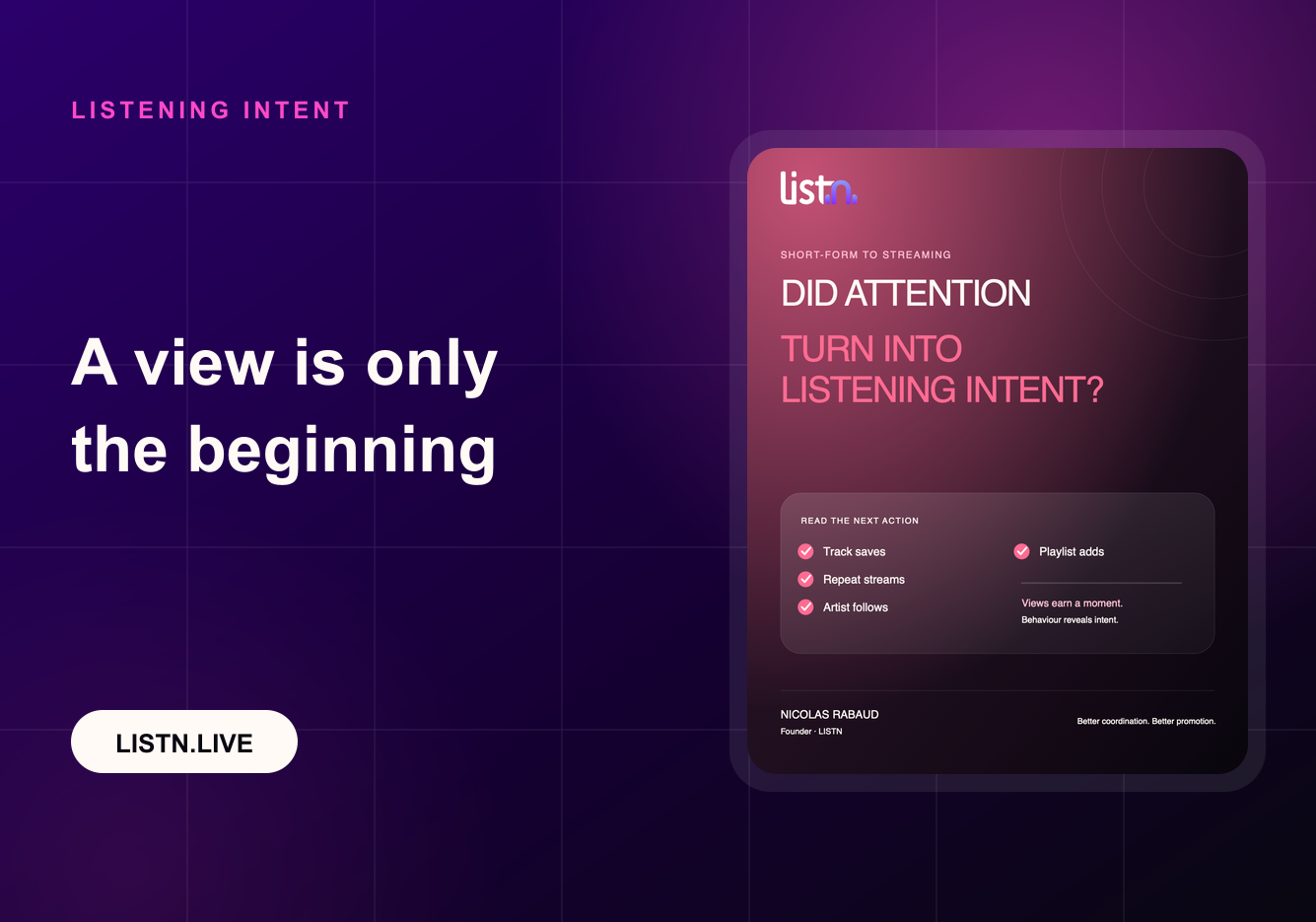
A short-form view is evidence that a creative earned attention. It is not proof that the viewer became a listener. For music campaigns, the more useful question is what happened after the view: did someone save the track, stream it again, follow the artist, add it to a playlist or explore the catalog?
This guide gives artists and labels a measurement framework for connecting TikTok, Instagram Reels and YouTube Shorts to listening intent without pretending that every platform action can be attributed perfectly.
Why views are only the first signal
Views are easy to compare and often available quickly. They are also shaped by platform definitions, autoplay behavior, loop mechanics, audience quality and distribution patterns. A large view count can be valuable, but it does not answer whether the content reached the right people or changed their relationship with the track.
TikTok reported in April 2026 that its Add to Music App feature generated more than six billion track saves over twelve months. The milestone shows that short-form discovery can lead directly to a streaming action. It does not mean every video or save will produce the same downstream result.
The attention-to-listening funnel
1. Exposure
The viewer encounters the clip. Track views, unique reach where available, completion rate and frequency. These metrics describe distribution and creative retention.
2. Interest
The viewer performs an in-platform action such as rewatching, liking, commenting, sharing, opening the profile or viewing more content. These actions suggest that the clip created more than passive exposure.
3. Listening intent
The viewer opens the sound page, uses an add-to-music feature, clicks a music destination or searches for the artist or track. This is the bridge between social attention and music consumption.
4. Listening behavior
The listener streams, saves, repeats, adds the track to a personal playlist, follows the artist or explores the catalog. These behaviors are closer to the release goal, although campaign-level attribution may be incomplete.
5. Retention
The listener returns after the initial discovery window. Sustained listening, repeat engagement and movement into a more active audience segment are more durable than one session.
Five music metrics to prioritize after views
Track saves
A save suggests that the listener wants future access to the track. It is a stronger expression of intent than passive exposure, but it should still be read alongside subsequent listening.
Repeat streams
Repeat listening suggests the track held attention after discovery. Compare the release baseline before and during the campaign rather than claiming that every repeat came from one clip.
Artist follows
A follow signals interest beyond one track and can improve the artist’s ability to reach listeners around future releases. Check whether follower growth persists after the campaign window.
Personal playlist adds
A personal playlist add places the song inside the listener’s own context. It can be a useful sign that discovery became a repeatable listening choice.
Catalog exploration
When listeners move from the promoted track to older releases, the content has introduced an artist rather than only a sound. Look for changes in streams across the catalog and active audience behavior.
Build the measurement plan before publishing
- Choose one primary listener behavior for the campaign.
- Record the pre-campaign baseline for social and streaming metrics.
- Use consistent destination links and UTM parameters where supported.
- Keep creative, audience and timing labels consistent in reporting.
- Define the campaign window and a post-campaign observation period.
- Write down which data cannot be connected at user level.
This prevents a common reporting problem: selecting the metric that looks best after the campaign instead of evaluating the behavior the creative was designed to produce.
Design creative around the next action
A clip should have one job. A performance moment may be designed to drive a full listen. A story clip may encourage profile exploration. A creator format may make the sound reusable. The hook, edit, caption and destination should support the same next action.
- Hook: earn attention in the opening seconds.
- Context: make the artist, track or emotional idea understandable.
- Proof: give the viewer a reason to stay or care.
- Destination: make the next music action easy.
- Measurement: define how the team will recognize intent.
Compare creatives by qualified behavior
One creative may generate cheaper views while another creates more profile visits, sound-page opens or music saves. If the campaign goal is listening intent, the second creative may be more valuable even with lower reach.
Compare variations using a shared audience, timing and budget whenever possible. Changing every variable at once makes it difficult to know whether the hook, creator, audience or distribution caused the difference.
How to report attribution honestly
Social and streaming platforms do not always expose a complete user-level path. Use direct link data, platform conversion features, timing, geographic movement and baseline comparisons as evidence, but separate observation from inference.
- Observed: the video produced a measured number of views and profile visits.
- Observed: track saves increased during the campaign window.
- Inference: the campaign may have contributed to the increase.
- Unsupported claim: every additional save was caused by the video.
This distinction makes the report more credible and protects the next budget decision from false precision.
Common short-form measurement mistakes
- Choosing the winning creative by views alone.
- Comparing platform view counts as if definitions were identical.
- Using a generic profile link with no campaign tracking.
- Ignoring the release baseline and natural launch-week movement.
- Claiming direct causation when the data only shows correlation.
- Ending measurement when the post stops receiving views.
Turn attention into a campaign learning system
The creative earns a moment of attention. The campaign workflow should make the next behavior visible enough to guide a decision. Define the listener action, build the clip around it, track the available evidence and scale the combinations that create qualified intent rather than cheap exposure.
For a structured creator activation, review the LISTN Creator Contest workflow and its reporting safeguards before assigning a budget.
Sources and review date
This guide was adapted from LISTN social publications released from August 11 to August 13, 2026, and reviewed on August 19, 2026.
TikTok Newsroom: Add to Music App passes six billion track saves