
A release campaign often sends every interested viewer towards one single. That makes sense when the immediate objective is a launch. But it can hide another opportunity: people may want to explore the artist, not simply replay the excerpt they already know.
Luminate's Social Media & Entertainment Discovery report offers a useful distinction. Among US music listeners who discover music on social media or short-form video, 58% say they listen to the artist's other music after finding music or an artist they like. Forty-four percent add new music or an artist to their playlists, while 43% listen to the specific song. [1]
These are reported behaviours, with multiple responses possible. They are not sequential conversion rates from a campaign. Their value is in showing that discovery can lead in several directions.
Build for curiosity about the artist
A viewer can enjoy a clip and still have no reason to explore the person behind it. Artist identity needs room in the creative: a distinctive performance, the story behind a lyric, or an explanation of how a sound was made.
The next destination should support that curiosity. If the video introduces an artist's wider world, a carefully chosen playlist or a clear artist page may serve it better than a landing page containing only the new single.
If the video promises a particular song, however, make that song the easiest thing to find. The destination should fulfil the promise that earned the click.
Prepare the catalogue before attention arrives
Choose a small number of relevant catalogue tracks. Think about the connection between them and the new release: a recurring theme, similar energy, or a recognisable production style.
That selection gives the team something concrete to work with when new listeners arrive. It can inform an artist playlist, a pinned introduction or a follow-up performance video. It also avoids presenting an unfamiliar listener with an undifferentiated list of releases.
For example, a song built around an acoustic performance could lead into another performance from the catalogue. A production-focused clip could point towards a track that develops the same sonic idea. These are editorial choices to test, not guaranteed paths to more streams.
Separate audiences before comparing results
Luminate also compares the broader discovery audience with music listeners who engage in at least four music-related activities on social or short-form platforms. Within that more engaged group, 69% report listening to the artist's other music and 59% report adding music or an artist to playlists. [1]
The comparison suggests that audience engagement matters. It does not establish that asking viewers to perform four activities will produce those results. Already-interested fans may behave differently from people seeing an artist for the first time.
That distinction matters when assessing creative. A video shown to existing fans and one reaching unfamiliar listeners should not be judged as if they had identical starting conditions.
Measure the outcome the content was designed to support
For a single-focused video, the immediate objective may be a visit to the release page. For an artist introduction, it may be exploration of a catalogue selection.
Record the destination and intended outcome before publishing. Then review the evidence available at each stage. Tracked visits show that someone reached a page. Streaming analytics may show changes in catalogue listening, but usually cannot identify every viewer's path from a social post.
Keep that limitation visible in campaign reviews. A useful result is a better-informed next decision, not an attribution claim the data cannot support.
The song that attracts attention can open the door. The release plan should make the rest of the artist's music worth exploring once someone walks through it.
Use LISTN Predict to choose the track worth reactivating
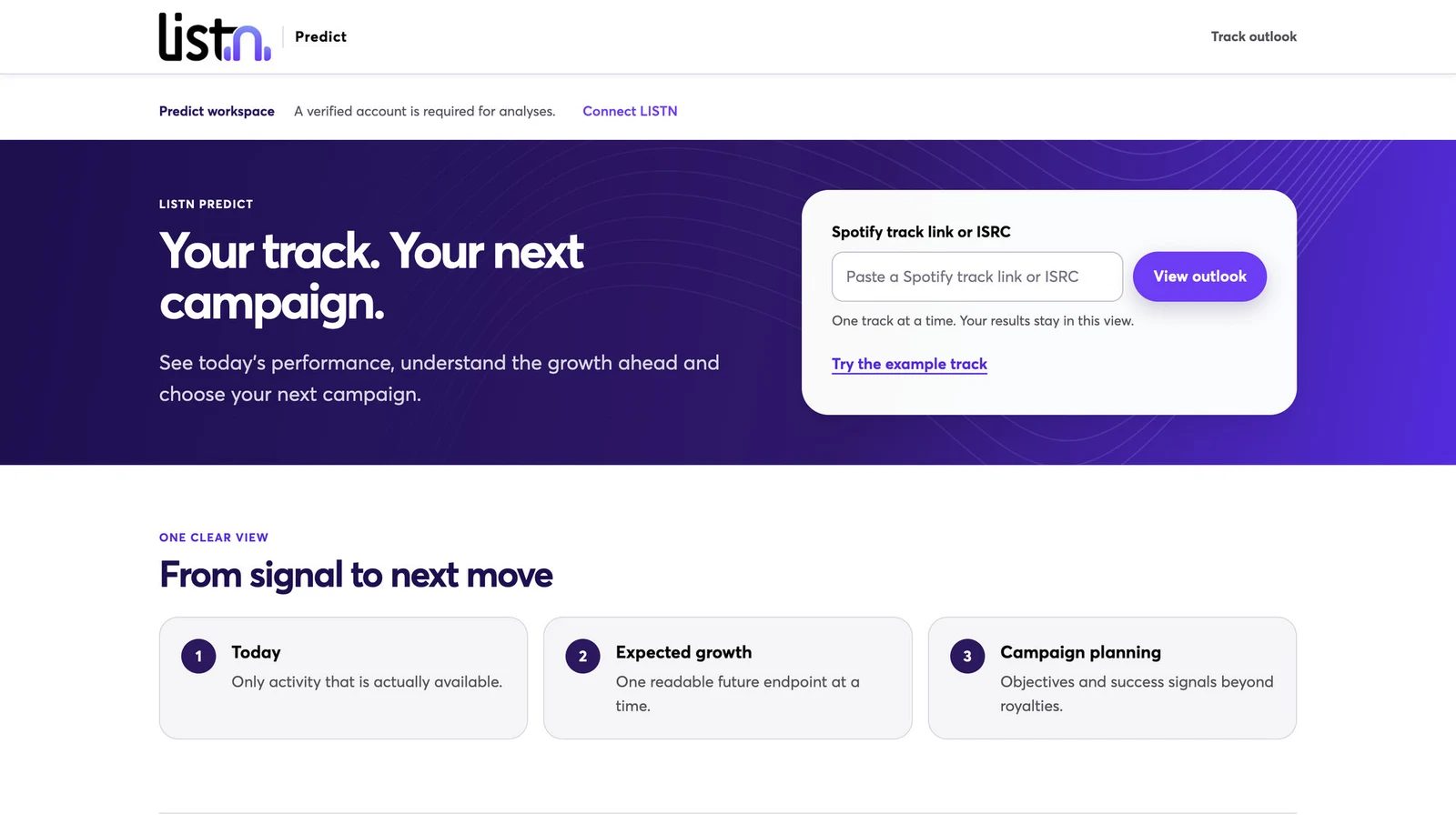
An older song can be the starting point of a new discovery campaign. LISTN Predict analyses a track's momentum and presents campaign-direction and upside scenarios.
For a catalogue project, review the candidate tracks individually, then combine those signals with the editorial connection you want a new listener to make. A song with a clear creative story and encouraging momentum gives the team a specific activation hypothesis.
From there, consider radio outreach first, then an influencer campaign where a short-form idea fits. Prepare the wider catalogue destination separately. LISTN helps inform which track to support and how to promote it; it does not replace the artist's own catalogue curation.
Have a catalogue track ready for another moment? Start with LISTN Predict.
Source
[1] Luminate, Social Media & Entertainment Discovery, October 2026, p. 17, U.S. Music 360, “Behaviors After Discovering Music on Social Media.” Base: US music listeners who discover music on social media or short-form video. Methodology: p. 18. Recommendations are editorial interpretation.
Read the original Luminate report and explore the LISTN product overview.
Continue the Luminate × LISTN series
Short-Form Video and Music Discovery: Plan the Next Step