
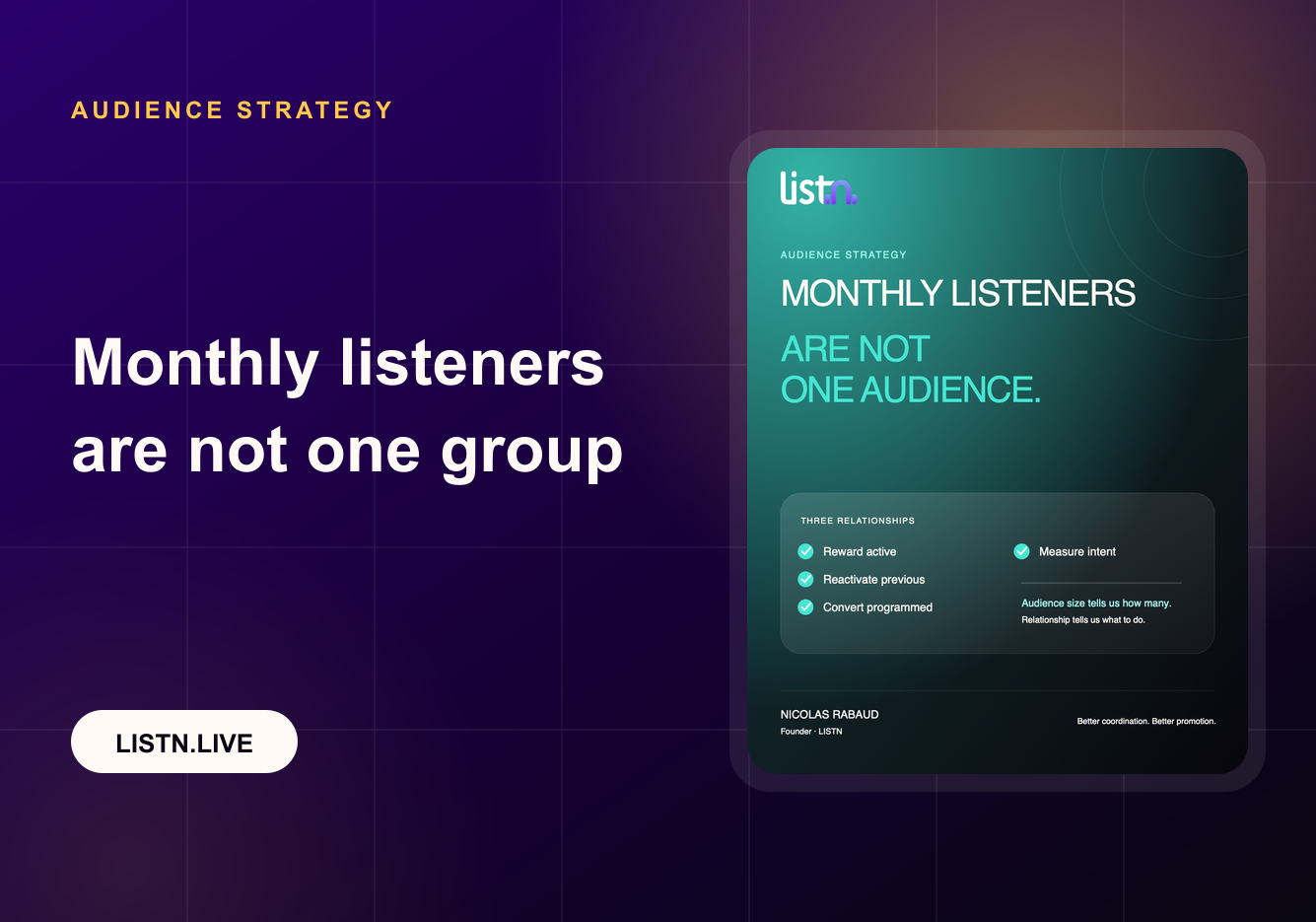
Spotify monthly listeners are not one audience. Some listeners intentionally choose the artist, some used to listen actively and others currently hear the music only through programmed sources such as editorial playlists, Discover Weekly, Radio, Autoplay or playlists made by other listeners.
Spotify for Artists groups these relationships into audience segments. Understanding the difference helps artists and labels choose a more relevant campaign message instead of treating every listener as equally close to the artist.
The three main Spotify audience groups
Spotify’s official audience-segmentation guide describes total audience across monthly active, previously active and programmed listeners. Each segment represents a different level and recency of intentional listening.
Monthly active listeners
These listeners intentionally streamed the artist during the past 28 days from active sources such as the artist profile, album and release pages, their library or their own playlists. They already choose the music directly.
Spotify further separates this active audience into super, moderate and light listeners. The exact campaign should reflect how deeply each group engages, but all three are closer to the artist than passive programmed discovery.
Previously active listeners
These listeners used to stream the artist intentionally but have not done so in at least 28 days. They may still encounter the music through programmed sources. Their past behavior makes them a reactivation audience rather than a completely cold audience.
Programmed listeners
These listeners have only streamed the artist from programmed sources during the relevant period. They may know a track through an editorial playlist, a personalized recommendation, radio-style listening or another user’s playlist without having intentionally chosen the artist.
Why monthly listener count is not enough
The headline monthly-listener number describes reach, but it does not explain the relationship behind that reach. Two artists can have the same monthly audience size and very different campaign needs. One may have a strong active base; another may depend heavily on programmed exposure.
A campaign should therefore ask both “how many people listened?” and “how did they listen?” The second question is more useful for deciding what behavior to encourage next.
Campaign job 1: reward active listeners
Active listeners already show intent. The campaign can deepen the relationship instead of introducing the artist from zero.
- Lead them to the full release or deeper catalog.
- Give them a reason to save, follow or return.
- Use artist context, process and release meaning rather than a generic introduction.
- Invite an action that matches their existing familiarity, such as tickets, community or direct fan channels when relevant.
Avoid spending the entire message explaining who the artist is. This group is more likely to need a reason to engage more deeply.
Campaign job 2: reactivate previously active listeners
Previously active listeners have historical intent but no recent active stream. The campaign needs to create a credible reason to return.
- Connect the new release to the track, era or context they previously chose.
- Use a clear “what changed” or “why now” message.
- Test catalog-led creative that reminds listeners of an existing relationship.
- Measure renewed active listening rather than impressions alone.
Reactivation is not the same as cold acquisition. The message can assume some familiarity while still making the new value explicit.
Campaign job 3: convert programmed discovery
Programmed listeners may recognize the song without recognizing the artist. The next step is to turn passive discovery into an intentional choice.
- Make the artist identity and release context clear.
- Lead with the track or moment most likely to be recognized.
- Give listeners an easy path to the artist profile or catalog.
- Measure active streams, saves, follows and catalog exploration where available.
A playlist placement or radio-style stream is an input. The outcome is whether the listener chooses the artist afterward.
Build three messages for one release
One release can support several audience jobs without requiring three unrelated campaigns. Keep the central release story stable and adapt the message, proof and next action.
For active listeners
“You know the sound. Here is the next chapter and the full release.”
For previously active listeners
“The artist you listened to before is back with a release connected to that earlier context.”
For programmed listeners
“You may know this track or sound. Here is the artist and where to explore next.”
How to read segment movement
Audience segments can change as listening behavior changes. A programmed listener can become active after intentionally visiting the artist, saving music or streaming from an active source. A formerly active listener can return. The useful reporting question is whether the campaign helped more listeners choose the artist directly.
Check segment distribution before the campaign, during a meaningful review window and after the initial release spike. Avoid attributing every movement to one tactic, especially when several channels and organic release activity overlap.
A practical Spotify audience workflow
- Open Audience, then Segments in Spotify for Artists.
- Record the current active, previously active and programmed audience mix.
- Choose the segment that matches the immediate release objective.
- Write a message and next action for that relationship.
- Select the channel most likely to reach that segment credibly.
- Review intentional listening, saves, follows and segment movement.
- Use the evidence to adjust the next creative or budget decision.
Common segmentation mistakes
- Treating all monthly listeners as equally engaged fans.
- Sending the same introduction to active and programmed listeners.
- Optimizing only for audience size instead of listener relationship.
- Assuming playlist discovery automatically creates active fans.
- Reading a short release-week spike as durable audience conversion.
Use audience relationship to choose the next campaign
Audience size tells you how many people listened. Audience relationship helps decide what the campaign should do next. Reward active listeners, give previously active listeners a reason to return and help programmed listeners make an intentional choice.
When you are ready to test promotion around that audience objective, explore LISTN campaign workflows across playlists, radio and creators.
Sources and review date
This guide was adapted from LISTN social publications released on August 17 and 18, 2026, and reviewed on August 19, 2026. Spotify definitions can evolve, so verify the current labels inside Spotify for Artists.
Spotify for Artists: the complete guide to audience segments