
Breakbeat is a rhythmic family rather than one fixed tempo or production recipe. Funky breaks, progressive breaks, electro-influenced tracks and bass-heavy club tools can share syncopated drums while asking for very different arrangements. The labels below remain active reference points in 2026. Before sending a demo, identify whether its centre of gravity is funk, rave, electro, house or cinematic progression, then compare it with each imprint's latest releases rather than its best-known historical records.
What makes a breakbeat demo work
Solo the rhythm section and listen quietly. The groove should remain clear without a lead synth or vocal forcing attention. Check the relationship between kick placement, snare weight and shuffled percussion, then bring the bass back and make sure it answers the drums instead of masking them. At full arrangement, every riser, fill and switch must support movement. Study recent catalogue tracks at matched loudness, noting intro length, breakdown scale, first-drop timing and whether the label favours compact singles or long DJ-friendly structures.
Representative artist: Plump DJs
Plump DJs remain a useful reference because their records make complicated syncopation feel immediate. A Plump Night Out helped define the muscular, funk-led UK breaks language associated with Finger Lickin', while later work expanded the palette through electro, rock textures and larger festival arrangements. Their 2026 twenty-fifth-anniversary activity also shows that the underlying design still translates: compact hooks, drums with clear swing and bass phrases built to converse with the beat. The practical lesson is hierarchy. A breakbeat track can contain edits, samples and effects without sounding crowded when the central groove is obvious. Producers should borrow that discipline, not vintage presets: make the first rhythmic identity recognisable, give each switch a function and preserve enough headroom for the transient pattern to remain physical.
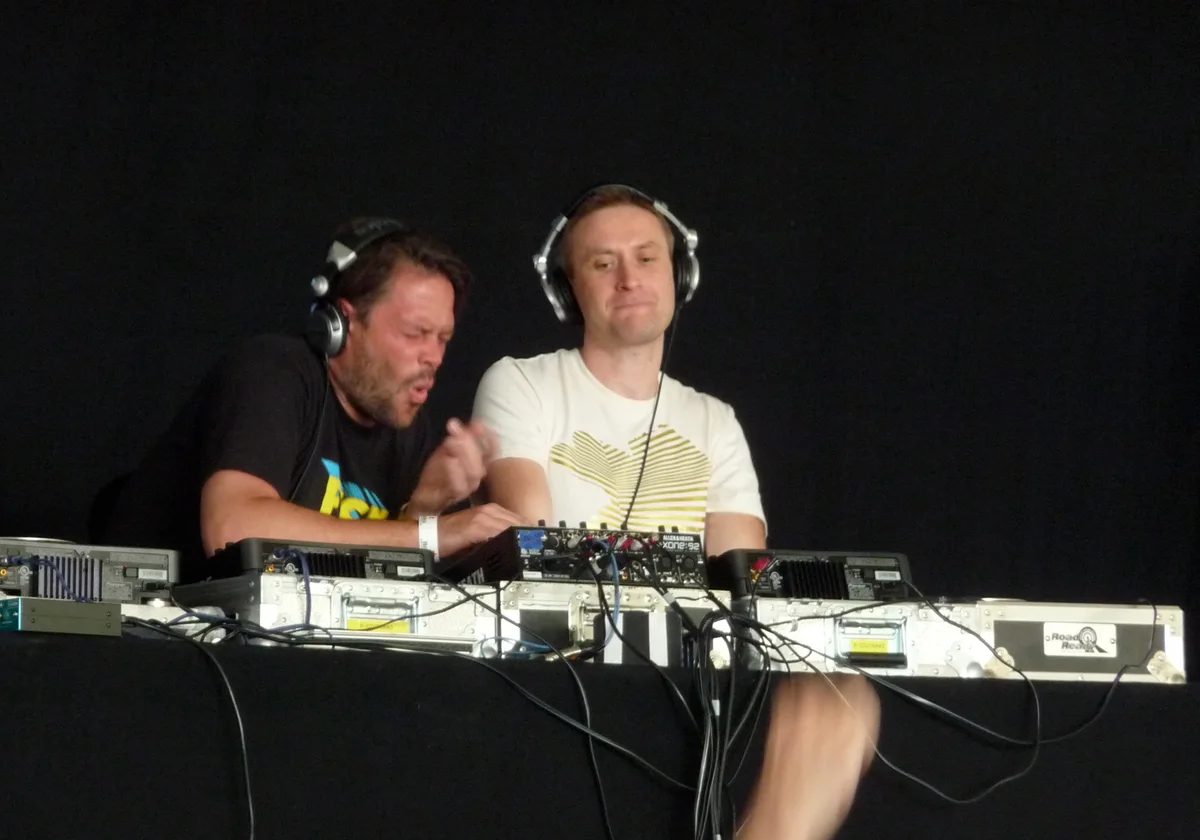
Cover: Plump DJs. Photo by Fred von Lohmann, via Wikimedia Commons, CC BY 2.0 (modified).

Top 10 breakbeat record labels
1. Breakbeat Paradise Recordings — funk-led breaks with continuity
Breakbeat Paradise Recordings has released vinyl and digital music since 2006, connecting funky breaks, hip-hop samples and party-ready basslines. Its current catalogue is a strong target for records with warmth and immediate movement. A suitable demo needs a hook that arrives quickly, drums that retain swing after mastering and sample use that is both legally clear and creatively transformed.
2. 83 — modern Spanish breaks at club scale
83 is closely associated with the contemporary Spanish breaks scene and artists such as GUAU, Yo Speed and Destroyers. The label favours engineered low end, sharp rhythmic changes and tracks that remain direct on a large system. Build one distinctive bass-and-drum exchange, keep the breakdown proportionate and make the second drop develop the idea rather than simply increase loudness.
3. Toast & Jam Recordings — prolific DJ-focused variety
Toast & Jam Recordings supports a broad stream of breaks, from rolling progressive tracks to vocal and funk-oriented club releases. Its volume makes precise catalogue research essential. Select two recent references that genuinely match the demo, keep blend points useful and provide clean metadata. A generic message to a prolific label is still generic; explain the exact rhythmic and tonal fit.
4. Diesel Recordings — underground breaks across shades and tempos
Diesel Recordings maintains an active catalogue spanning techy, progressive and bass-heavy breakbeat. The common requirement is functional momentum. A fitting production should have controlled sub energy, readable percussion and transitions that help a DJ change pressure smoothly. Avoid over-limiting the master, because dense break patterns lose impact when every transient is pushed to the same level.
5. Bomb Strikes — funk, bass and crossover energy
Bomb Strikes links breaks with funk, hip-hop, disco and bass music through singles and its Funk N' Beats compilation series. The imprint suits records with a human groove and a clear central sample or performance. Tighten the low mids, clear all borrowed material and make sure the track offers more than a familiar vocal placed over a standard break.
6. Distorsion Records — hard-edged electronic breaks
Distorsion Records focuses on forceful breakbeat shaped by electro textures, aggressive bass design and club-ready drops. It is relevant when a track has a defined sonic signature rather than layers of interchangeable distortion. Organise the frequency conversation between kick and bass, control harsh resonances and keep the central riff legible when the arrangement reaches maximum density.
7. Elektroshok Records — Spanish breaks with melodic reach
Elektroshok Records connects Spanish breakbeat energy with melodic, vocal and progressive ideas. Its catalogue can accommodate emotional breakdowns when the groove returns with conviction. A suitable demo should introduce its motif early, avoid an overlong pause and deliver a mix in which vocal presence, upper bass and snare attack do not compete for the same space.
8. V.I.M. Records — progressive depth and international range
V.I.M. Records has long supported progressive breaks, tech-funk and related club music from an international producer network. The imprint is a logical target for tracks that develop patiently through modulation and layered rhythm. Keep the arc audible at low volume, automate texture with purpose and leave enough introductory and closing structure for the record to function in a long mix.
9. Diablo Loco Records — playful pressure and vivid hooks
Diablo Loco Records favours colourful, bass-driven breaks with a comic-book sense of energy. Behind that personality, the releases depend on disciplined drum programming and memorable drop construction. Send music with an identifiable hook, robust mono-compatible low end and concise changes. Novelty sounds should reinforce the track's identity rather than replace a durable groove.
10. Fantomas Records — darker cinematic breakbeat
Fantomas Records provides a home for darker, atmospheric and tech-oriented breaks. Its releases often use cinematic texture around heavy percussion and bass. A fitting demo needs contrast: preserve space before major impacts, keep long effects away from the sub and make the dramatic theme recur in a recognisable form. Mood should strengthen DJ function, not obscure it.
LISTN Breakbeat radio coverage
LISTN maps Breakbeat campaigns to its breaks category. As of September 13, 2026, this category covers 162 distinct radios across 35 countries. The five leading countries are the United Kingdom (31), the United States (29), Germany (13), Australia (10) and Spain (9).
Complete radio count by country
United Kingdom: 31; United States: 29; Germany: 13; Australia: 10; Spain: 9; Brazil: 8; France: 7; Argentina: 6; Canada: 5; Italy: 5; Netherlands: 4; Belgium: 3; Colombia: 3; Russian Federation: 3; India: 2; Japan: 2; Latvia: 2; South Africa: 2; Uruguay: 2; Bolivia: 1; Bulgaria: 1; Chile: 1; Cyprus: 1; Ecuador: 1; Egypt: 1; Estonia: 1; Finland: 1; Ghana: 1; Honduras: 1; Hungary: 1; Lithuania: 1; Mexico: 1; Nicaragua: 1; Turkey: 1; Zambia: 1.
Build a focused breakbeat campaign
Prepare a lossless master, clean radio edit where useful, BPM, full credits, sample clearances and two recent catalogue references. Describe the record precisely: funky breaks, progressive breaks, electro breaks or bass-led club breakbeat. Choose a preview that includes both the groove and the main payoff. Programmers need to hear the rhythmic identity, not only a cinematic introduction.
Use existing listener, touring and previous-support data to prioritise countries, then inspect current station schedules and recent tracklists. The coverage above sets the research order; programme fit determines the final list. Keep artwork, metadata and versions consistent across every destination. When the finished master and target shows align, build a focused LISTN campaign.