
Electro house puts the synthesizer at the centre of the dancefloor: distorted bass, sharply articulated riffs and drops that turn a short motif into the main event. Start with mau5trap, Dim Mak and Monstercat to hear three different interpretations, then explore the Dutch labels connecting that sound to festival stages and bass-heavy club music.
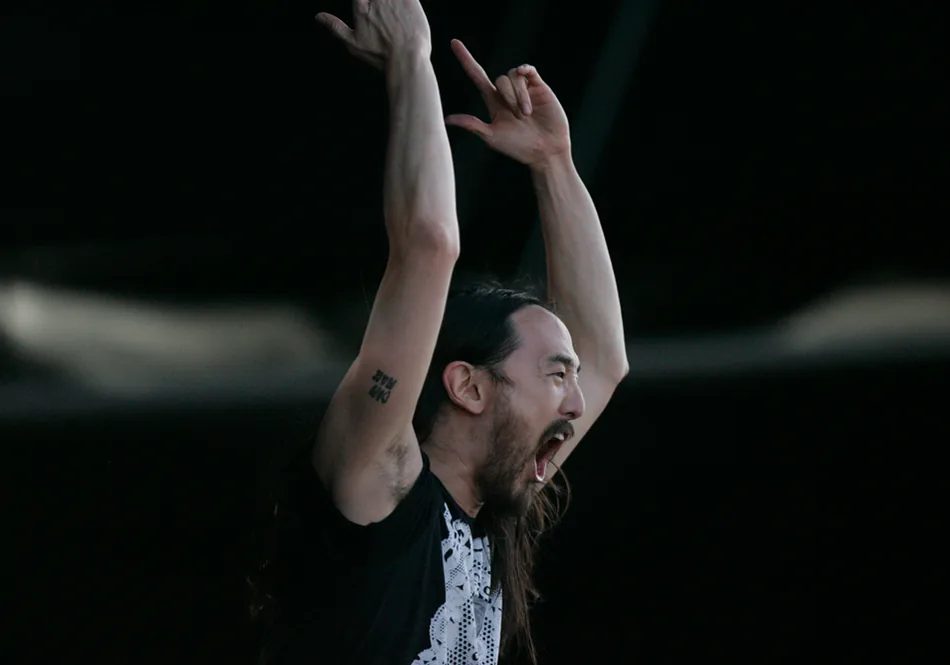
Cover: Steve Aoki at Future Music Festival, Sydney, March 9, 2013. Photo by Eva Rinaldi, via Wikimedia Commons, CC BY-SA 2.0 (modified).
.jpg)
Find the label that matches your central riff
A buzzing, intricately chopped lead belongs in a different listening conversation from a sparse, swung bass hook. Identify the feature carrying your record before choosing catalogue references. This selection follows electro house's detailed sound design, festival impact and connections to bass and future house. For chord-led journeys, explore our Progressive House guide; for percussion-first grooves, visit Tech House.
Representative artist: Steve Aoki
Steve Aoki helped bring electro house's abrasive synths and explosive transitions into a wider festival vocabulary. His signature combines distorted lead hooks, sharply separated build-ups and drops, and vocal collaborations that give instrumental energy a memorable human anchor. Wonderland (2012) captures his collision of electronic production with guest singers and rappers; Neon Future I (2014) expands that approach into a more melodic, futuristic album world. Dim Mak, the label he founded in 1996, is his third essential project: a continuing meeting point for club producers and crossover performers. The official 2026 thirtieth-anniversary tour announcement brings that history into the present, pairing Aoki with artists including Laidback Luke, Nostalgix and The Bloody Beetroots across its tour and Ultra stage programme. His relevance lies in connecting a recognizable production language with collaborative records and a sustained live community.
Top 10 electro house labels
1. mau5trap — intricate electro sound design
deadmau5's mau5trap is the strongest starting point for electro house built from detailed synthesis. Its catalogue history includes Feed Me, Zedd and Noisia, while its current channel features ZYRANOX's “NETWORKING” and “ASCENSION” alongside BlackGummy remixes. The distinction is architectural: timbre, rhythmic editing and tension can carry the identity of a record as clearly as a vocal. Explore the darker electronic edge first.
2. Dim Mak — the collision of club music and live energy
Steve Aoki's Dim Mak connects electro house to the unruly performance tradition of The Bloody Beetroots and Deorro. Its 2026 anniversary programme places that lineage beside newer bass artists, while the release channel includes Aoki, Ely Oaks and SACHA's “Gravity.” The label's defining asset is that exchange between producer-led club records, vocal crossover and a stage culture with a strong physical identity.
3. Monstercat — precision with a melodic payoff
Monstercat's Bad Computer catalogue provides a concentrated route into polished electro production. “When You're Not Around” with ROY KNOX, “Connected” featuring Gold and “4D” with Ryan Coss offer distinct listening points. Bad Computer's official biography describes the meeting of early-2010s dance inspiration and sharp, euphoric production. That balance makes the label especially relevant when technically elaborate synth work still resolves into an immediate song.
4. STMPD RCRDS — electro's bass-house evolution
STMPD RCRDS connects Martin Garrix's electronic production world with artists including Julian Jordan, Dyro and Seth Hills. The label's current channel highlights Jordan's “Bad Btch” and Curbi's “Down To The Sound.” Its attraction is the evolution from expansive electro riffs toward compact, rhythmically aggressive bass hooks. The accompanying STMPD radio sets place those productions inside actual DJ sequences, revealing how their contrasting drops interact.
5. Revealed Recordings — mainstage-scale tension and release
Hardwell's Revealed Recordings makes the festival-facing branch easy to navigate through its Big Room, Mainstage and EDM catalogue tags. Hardwell and W&W's “Bangkok” and Dirty Signal with Blink's “The World Never Sleeps” are current reference points. The specific reason to investigate Revealed is arrangement scale: forceful rhythmic figures and clearly staged peaks designed to communicate across a large audience.
6. Spinnin' Records — the remix as a club translation
Spinnin' Records brings electro-house production into contact with a broad dance-song catalogue. Its 2026 channel includes the AFROJACK remix of Justė, Jaxstyle and Jon's “Turn The Lights Off,” plus regular New Music Friday mini-mixes. The useful angle is transformation: compare an original song's topline and structure with a producer's club version to understand which elements survive a more forceful rhythmic setting.
7. Musical Freedom — bounce between the big-room moments
Tiësto's Musical Freedom is an important catalogue for the meeting of electro impact and spring-loaded bass grooves. Cheyenne Giles and Knock2's “DVNCEFLOOR” offers a focused starting point; Giles' official artist biography documents his 2019 signing and “Big Room Bounce” identity. That emphasis on movement between impacts distinguishes the label from a purely build-and-drop approach. Follow the bass rhythm as closely as the lead.
8. HEXAGON — future-house colour and electronic punch
Don Diablo's HEXAGON connects classic house foundations with futuristic sound design. His published statement identifies “Freek Like Me” as the beginning of HEXAGON 2.0 and calls the direction “NeoNostalgia.” The label's current demo categories include House, Bass House and Club Bangers. It earns its place at electro house's brighter edge, where a distinctive synth character and familiar house phrasing can reinforce one another.
9. Protocol Recordings — festival production with a song-led side
Nicky Romero's Protocol Recordings places hard-hitting festival tracks beside melodic vocal releases. Its official introduction to VIVID's “Gas” describes the Tokyo producer's mainstage approach, while Blackcode and Jordan Jade's “Versions Of Me” occupies the song-led side of the current catalogue. Protocol is worth exploring for that contrast: how to retain a clear musical theme while changing the intensity and density of the production around it.
10. Hysteria Records — compact hooks and a rolling release programme
Bingo Players' Hysteria Records connects an electro-house lineage with today's bass and tech-house grooves. ABSA's “LOWkEY,” released August 28, 2026, and AANSE's “Drinks Everywhere” provide recent bass-house entry points. Its regular releases and Hysteria Radio episodes make it a useful study in concise club identity: a central hook, economical development and enough rhythmic space for a DJ to keep the set moving.
LISTN electro house radio coverage
LISTN maps Electro House campaigns to its house category. As of September 9, 2026, this category covers 665 distinct radios across 79 countries. The five leading countries are the United Kingdom (96), Germany (57), France (52), the United States (52) and Spain (50).
Complete radio count by country
United Kingdom: 96; Germany: 57; France: 52; United States: 52; Spain: 50; Italy: 43; Netherlands: 25; Argentina: 23; Chile: 18; Australia: 17; Belgium: 16; Colombia: 15; Canada: 14; Greece: 12; Hungary: 12; Portugal: 12.
Romania: 10; Brazil: 9; South Africa: 9; Bulgaria: 7; Ecuador: 7; Croatia: 5; Peru: 5; Switzerland: 5; Israel: 4; Mexico: 4; Poland: 4; Russian Federation: 4; Venezuela: 4; Costa Rica: 3; Ghana: 3; Ireland: 3.
Uruguay: 3; Austria: 2; Bolivia: 2; Cyprus: 2; Denmark: 2; Dominican Republic: 2; Luxembourg: 2; Malta: 2; Monaco: 2; New Zealand: 2; Nicaragua: 2; Pakistan: 2; Sint Maarten (Dutch part): 2; Slovakia: 2; Sweden: 2; Thailand: 2.
Zambia: 2; Albania: 1; Armenia: 1; Aruba: 1; Egypt: 1; Estonia: 1; Finland: 1; Georgia: 1; Honduras: 1; Hong Kong: 1; India: 1; Indonesia: 1; Iraq: 1; Isle Of Man: 1; Japan: 1; Kenya: 1.
Kosovo: 1; Latvia: 1; Lithuania: 1; Montenegro: 1; Panama: 1; Paraguay: 1; Philippines: 1; Saint Lucia: 1; Serbia: 1; Taiwan, Province of China: 1; Tunisia: 1; Turkey: 1; Uganda: 1; Ukraine: 1; United Arab Emirates: 1.
Build a campaign around the audible hook
Describe the sound in one sentence. “A chopped synth riff over a driving four-on-the-floor kick” communicates more than a string of genre tags. Add one or two close catalogue references, the release date, credits and a private listening link.
Prepare purposeful versions. Keep a DJ-friendly extended mix and a shorter edit that reaches the hook quickly. Check the transition into the first drop, vocal intelligibility and the balance between bass and kick. Name every file with the artist, track and version.
Organize outreach by programme. Use the country counts to build research groups, then review recent shows for comparable records. Note the version sent and follow-up date. Bring that focused release package to LISTN Pitch.