
Progressive trance creates momentum through evolution rather than constant resets. Bass patterns, percussion and harmonic details develop over long phrases, while the main release often arrives with less theatrical interruption than in festival trance. That makes label fit especially important: an imprint's approach to pacing can matter as much as tempo or sound palette. The ten labels below offer distinct references for deep, melodic, psychedelic and main-floor interpretations of the form.
Separate progressive trance from its neighbours
Start with arrangement. Progressive trance normally keeps a trance-like sense of propulsion and harmonic anticipation while allowing ideas to unfold gradually. Our trance labels guide covers the broader spectrum, including uplifting and tech-trance, while the progressive house selection follows lower-slung grooves and more house-led rhythmic language. For a demo, identify where your record sits between those poles. Note the BPM, the length of the main development and whether the defining feature is hypnotic repetition, melody, atmosphere or a psychedelic sound-design sequence.
Representative artist: John 00 Fleming
John 00 Fleming remains a defining progressive trance artist because his records and extended sets protect the genre's long-form logic. His 2026 album The Lost Tribe uses eighteen tracks to move through deep trance, progressive tension and psychedelic detail, with collaborations involving Paul van Dyk and Astral Projection widening that frame. The monthly JOOF Radio programme is equally instructive: its patient transitions show how a record can earn intensity without relying on an immediate drop. JOOF Recordings, the label he founded, turns that philosophy into a current release platform for artists including Basil O'Glue, The Digital Blonde and Nomas. Fleming's continued relevance comes from treating atmosphere and development as functional club tools. Producers can study how his bass lines remain steady while timbre, spatial depth and harmonic pressure change around them, then apply that discipline to an extended mix that still has a clear identity within its first minute.
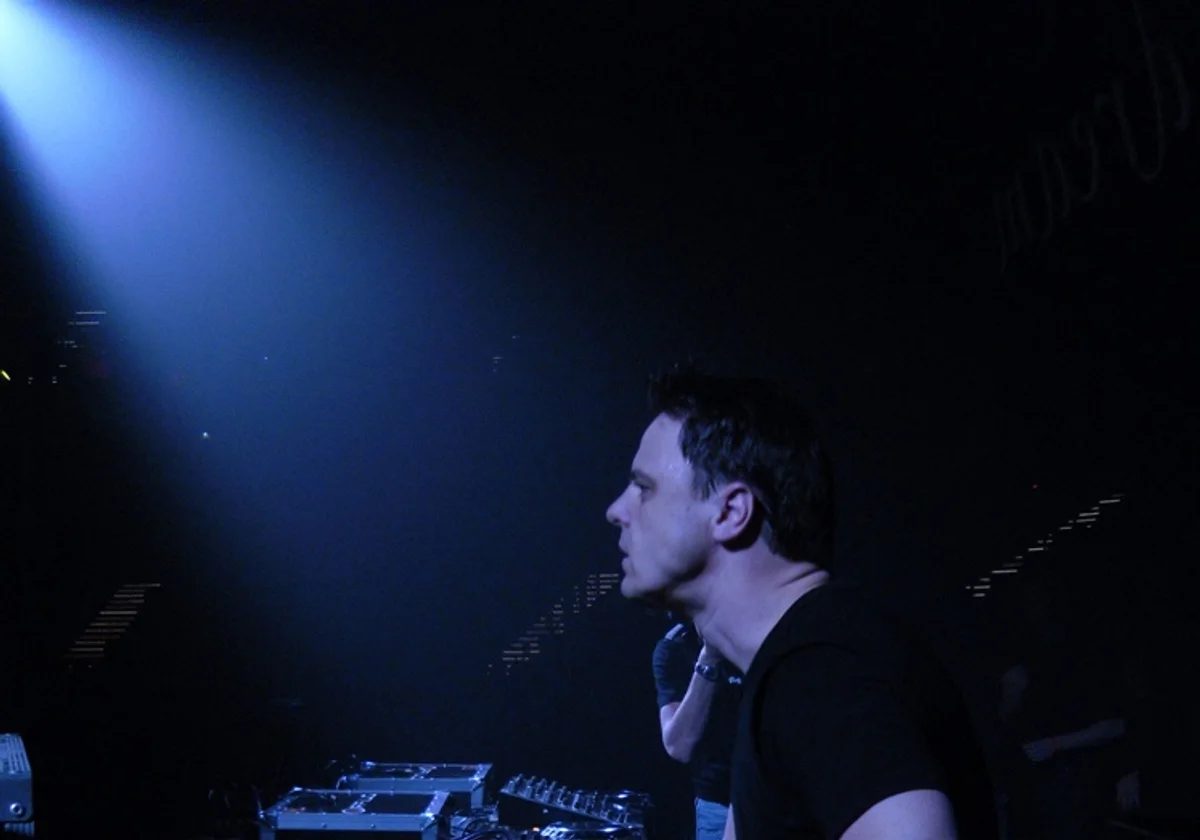
Cover: Markus Schulz. Photo by Piotr Drabik, via Wikimedia Commons, CC BY 2.0 (modified).

Top 10 progressive trance labels
1. JOOF Recordings — long-form depth before easy payoff
JOOF Recordings is the clearest starting point for progressive trance that values hypnosis, detailed sound design and extended development. Its current output moves between deep trance, progressive and psychedelic territory through John 00 Fleming, The Digital Blonde, Basil O'Glue and newer specialists. The catalogue rewards producers who can sustain tension across eight minutes without padding. Before submitting, test whether each new layer changes the track's direction and whether the final third resolves ideas introduced near the opening.
2. Pure Progressive — melody with a deeper centre of gravity
Solarstone's Pure Progressive focuses on the deeper branch of the Pure Trance sound. The label gives melodies room to breathe, but keeps grooves measured and avoids turning every breakdown into an oversized peak. Basil O'Glue, Orkidea, Solarstone and their collaborators provide useful references for balancing emotional harmony with disciplined club structure. It suits demos whose melodic theme grows through variation rather than appearing only as a single dramatic hook.
3. Enhanced Progressive — modern melodic clarity
Enhanced Progressive entered a refreshed phase in 2026 while retaining the melodic DNA built through more than 600 releases. Farius, Ruben de Ronde, Steve Brian and DT8 Project show how the imprint connects progressive trance architecture with clean contemporary low end and concise hooks. Its strongest lesson is economy: arrangements can develop patiently without obscuring the central idea. Producers should prepare an extended mix for flow and a shorter version whose emotional sequence remains intact.
4. Anjunabeats — progressive scale through songwriting
Anjunabeats continues to place progressive and trance records in the same living catalogue. Above & Beyond, Andrew Bayer, Oliver Smith, PROFF and newer artists demonstrate different balances of vocal writing, rolling groove and melodic release. The label is most relevant when a track has a memorable musical statement beyond its production finish. Study how motifs return in altered forms and how vocals, if present, influence the entire arrangement rather than decorating a breakdown.
5. Coldharbour Recordings — pressure, shadow and forward motion
Markus Schulz's Coldharbour Recordings remains a home for darker progressive trance, techno-inflected drive and atmospheric main-floor records. Its 2026 catalogue includes Nemke, Elias Erium, ReDub and Mike EFEX, maintaining the imprint's preference for weight and tension. Coldharbour is a strong reference when low-end movement carries the narrative. Keep percussion purposeful, make the breakdown preserve the record's darker tone and avoid introducing brightness that contradicts the opening.
6. Electronic Architecture — deep trance across wider textures
Curated by Solarstone, Electronic Architecture explicitly spans progressive house, deep trance, techno and electronica. That wider frame is valuable for producers whose records resist a single narrow genre tag. The label favours immersive spatial design and transitions that feel architectural rather than abrupt. Use it as a reference when field-like ambience, unusual synthesis or breakbeat detail supports a trance pulse. Every atmospheric element should still advance the composition instead of sitting above it.
7. FSOE UV — warm progressive movement with trance context
FSOE UV was created within Aly & Fila's Future Sound of Egypt group with Paul Thomas directing its progressive lane. The catalogue's melodic grooves connect progressive house pacing to a recognisable trance ecosystem, making it useful for records that live on the genre boundary. Focus on bass-line character, gradual harmonic lift and a mix that remains fluid at lower intensity. A good fit should work early in a set without sounding like a reduced peak-time track.
8. AVA Recordings — detailed melody built for the club
Andy Moor's AVA Recordings gives progressive trance a polished, musical outlet. The imprint has long connected intricate chord movement, vocal material and robust club engineering, with a catalogue that rewards both close listening and DJ use. It is a practical target for producers whose lead or vocal carries emotional specificity. Keep the supporting layers controlled, preserve dynamic contrast and ensure the extended sections offer genuine mixing value rather than repeated bars.
9. Lost Language — progressive heritage with an active catalogue
Lost Language links the progressive trance vocabulary of the early 2000s to new releases and carefully chosen returns. Tilt, Space Manoeuvres, LostLegend and the label's varied remix projects show how durable motifs can be reframed without becoming nostalgia exercises. Its catalogue is especially useful for studying alternative mixes: compare how rhythm, atmosphere and harmonic emphasis change while the composition remains identifiable. Submit material with a strong musical core that can support more than one interpretation.
10. Forescape Digital — the deep and hypnotic edge
Enlusion's Forescape Digital concentrates on deep, hypnotic trance and progressive music. Its restrained sound offers a distinct endpoint for tracks that build through bass pressure, subtle modulation and shadowed ambience rather than large melodic declarations. This is a catalogue to study at full length and on good headphones. Producers should check phase, stereo movement and low-frequency control carefully, because small technical imbalances become obvious when the arrangement intentionally leaves space.
LISTN Progressive Trance radio coverage
LISTN maps Progressive Trance campaigns to its trance category. As of September 11, 2026, this category covers 248 distinct radios across 58 countries. The five leading countries are the United Kingdom (39), Germany (29), the United States (21), France (20) and Spain (13).
Complete radio count by country
United Kingdom: 39; Germany: 29; United States: 21; France: 20; Spain: 13; Australia: 11; Netherlands: 11; Italy: 10; Canada: 6; Russian Federation: 6; Belgium: 5; Brazil: 4; Chile: 4; Colombia: 4; Hungary: 4; Romania: 4; Argentina: 3; Israel: 3; Mexico: 3; Slovakia: 3; South Africa: 3; Venezuela: 3; Ireland: 2; Peru: 2; Poland: 2; Algeria: 1; Aruba: 1; Austria: 1; Bolivia: 1; Cyprus: 1; Denmark: 1; Dominican Republic: 1; Ecuador: 1; Egypt: 1; Estonia: 1; Finland: 1; Georgia: 1; Ghana: 1; Greece: 1; Hong Kong: 1; India: 1; Indonesia: 1; Isle Of Man: 1; Japan: 1; Kenya: 1; Kosovo: 1; Kyrgyzstan: 1; Lithuania: 1; Luxembourg: 1; Namibia: 1; Nicaragua: 1; Norway: 1; Pakistan: 1; Sweden: 1; Switzerland: 1; Thailand: 1; Uganda: 1; Uruguay: 1.
Build a campaign around progression
Describe the track's movement in concrete terms. State the BPM, original mix length and the point where its central motif first becomes clear. Name two close label references and explain whether the record leans deep, melodic, psychedelic or main-floor. Supply lossless audio, accurate credits, clean artwork and both extended and radio-ready edits when they exist.
Then narrow the geography using real listener, support or touring signals. The country counts above provide a research order; recent programme tracklists determine the final match. Choose a preview section that reveals the groove and atmosphere together, because a breakdown alone can misrepresent progressive trance. When the arrangement, label references and target shows align, build a focused LISTN campaign.