
Synthwave works when its references become a language rather than a costume. Gated drums, analogue-style bass, widescreen pads and bright arpeggios can point toward the 1980s, but the strongest releases use those materials to build a distinct emotional world. Labels now divide that world into cinematic outrun, vocal synthpop, dreamwave, darksynth and heavier hybrid forms. For artists, the useful question is which catalogue already speaks to the pacing, songwriting and production choices in a finished release. These ten active labels provide clear reference points in 2026.
Define the world before polishing the surface
Start with the scene your track implies. A night-drive instrumental needs movement across four or five minutes; a vocal track needs a chorus that survives without production spectacle; darksynth needs physical low end and tension that develops rather than merely staying loud. Choose a small set of recurring timbres, then automate them across the arrangement. Compare several recent releases from each target label, paying attention to vocal treatment, guitar density, drum transients and how quickly the central hook arrives.
Representative artist: Perturbator
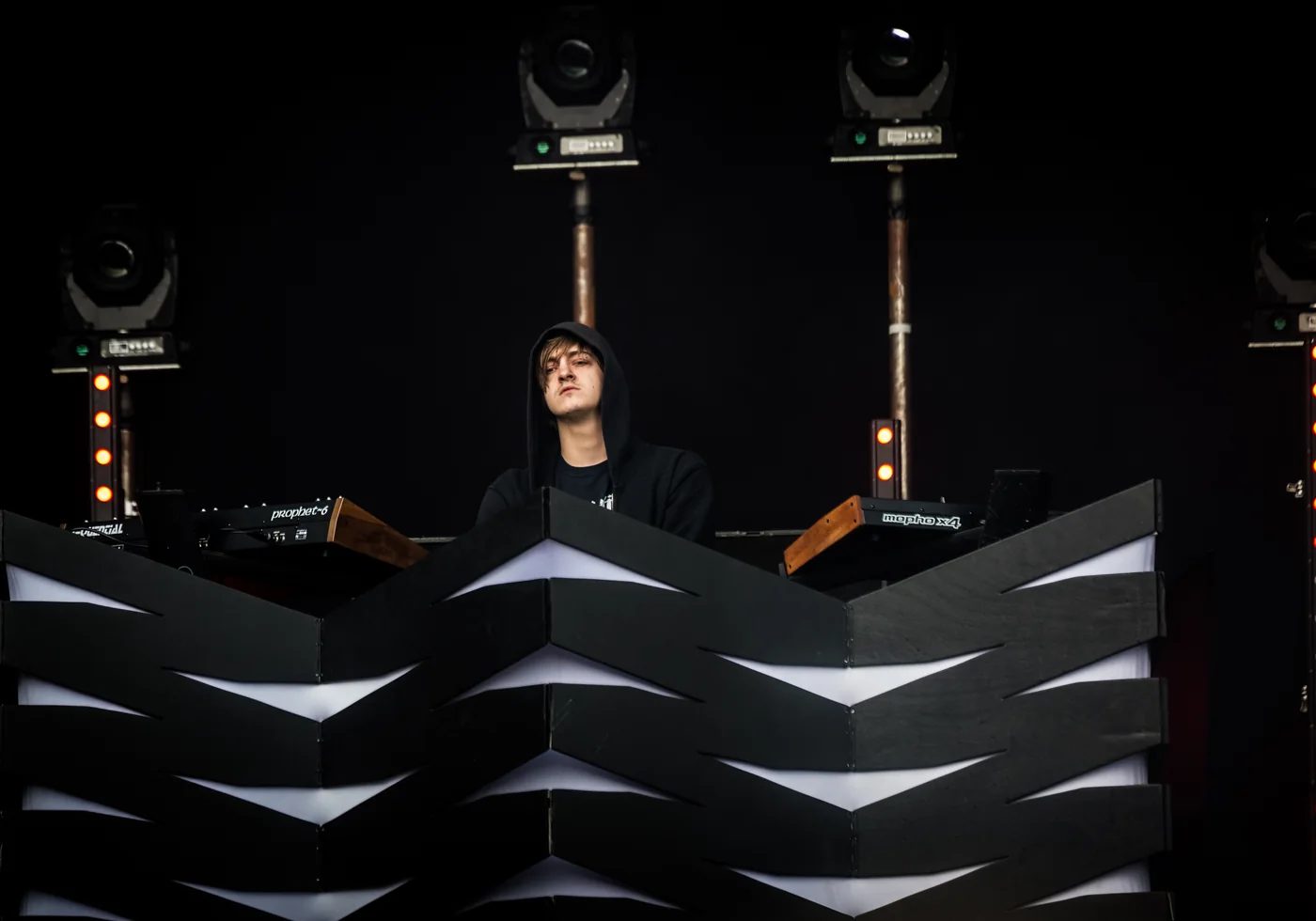
Perturbator, the project of French producer James Kent, shows how synthwave can evolve without losing its cinematic centre. Dangerous Days made his combination of sequenced momentum, horror atmosphere and metallic scale a darksynth benchmark. The Uncanny Valley sharpened that world through tracks such as “Neo Tokyo” and “Sentient”, while Lustful Sacraments opened the sound toward post-punk, industrial rock and more exposed vocals. His 2025 album Age of Aquarius continued that expansion, and an extensive 2026 tour has kept the material connected to a live audience. His relevance lies in the continuity between eras: drum programming, bass pressure and visual atmosphere remain recognisable even when the songwriting frame changes. Producers can take the same approach by identifying two or three core musical rules, then letting each project challenge the format around them.
Cover: Perturbator performing at Rock am Ring on June 4, 2017. Photo by Andreas Lawen (Fotandi), via Wikimedia Commons, CC BY-SA 4.0 (modified).

Top 10 synthwave record labels
1. NewRetroWave Records — the broadest current synthwave platform
NewRetroWave Records connects a large audience-facing channel with a catalogue spanning outrun, dreamwave, synthpop and cyberpunk electronics. Its 2026 schedule includes Missing Words' Serotonin, while a deep roster links Robert Parker, Mecha Maiko, DEADLIFE and ALEX & Tokyo Rose. The label suits projects with an immediate visual and melodic identity. Lead with the track that establishes the world fastest, and make sure the artwork, title and release sequence feel like parts of the same story.
2. TimeSlave Recordings — a deep home for UK synthwave
TimeSlave Recordings maintains one of the scene's most extensive independent catalogues, balancing new albums, physical editions and careful returns to important records. Sandor Gavin's Afterlight, Sleepless Nights' Moments Lost in Time and New Arcades' A Night to Reflect all arrived in 2026. Its range covers melodic night-drive music, darker outrun and vocal releases. Artists should submit a coherent release rather than a folder of unrelated tracks, with masters and artwork ready for a physical-format conversation.
3. Aztec Records — synthwave built around songs and voices
Aztec Records places retrowave, synthwave and synthpop in the same London catalogue, with Bunny X, The Lightning Kids, NINA and Cassetter among its useful reference points. The 2026 Pure Female Synthwave, Vol. 1 compilation and continuing Pure Synthwave series show a curatorial focus on complete songs as well as producer-led tracks. Strong toplines, precise vocal editing and clean instrumental versions matter here. Present the chorus early and explain the project's visual direction in one concise paragraph.
4. Rosso Corsa Records — classic outrun with melodic discipline
Rosso Corsa Records helped establish the melodic, automotive side of synthwave through artists such as Mitch Murder, Miami Nights 1984, Lazerhawk and Betamaxx. Morgan Willis' 2026 album Heat confirms that the catalogue still develops the form rather than functioning only as an archive. Producers should remove ornamental layers until the main theme carries the track, then restore only details that improve momentum.
5. FiXT — the bridge from synthwave to modern rock
FiXT operates across electronic rock, alternative metal and cinematic music, but its roster retains a strong synthwave axis through 3FORCE, Mega Drive, Scandroid, Signal Void, Fury Weekend and LeBrock. It is a practical target for projects where retro synthesis supports guitars, large vocal hooks or sync-ready structure. The mix must leave room for both programmed detail and rock impact. Supply accurate stems, instrumental versions and concise metadata, because the catalogue's licensing orientation rewards organised delivery as much as a strong master.
6. Lazerdiscs Records — French curation from outrun to dark club music
Lazerdiscs Records grew from the Drive Radio community and maps a wide lane between synthwave, futuresynth, neodisco and slow-motion techno. Its catalogue includes Absolute Valentine, Niky Nine, Robert Parker, Stilz and Shredder 1984; Absolute Valentine's 2026 single “Tearstained Uprising” keeps that activity current. The label is well suited to tracks with club-weight rhythm and cinematic framing. Check the kick-bass relationship at low volume and avoid over-limiting the dramatic transitions that give the arrangement scale.
7. Girlfriend Records — independent synth music with scene depth
Girlfriend Records has connected synthwave, outrun, vaporwave and French-touch influences since 2010. Run by Johnatron after its foundation by Sferro, the label's large catalogue supports both specialist artists and soundtrack-facing projects, with new releases continuing through September 2026. It rewards personality more than a single fixed production template. A fitting pitch should identify the emotional function of the track—romantic, playful, tense or arcade-driven—and demonstrate that function within the first minute.
8. Retrowave Touch Records — compilations and soundtrack pathways
Retrowave Touch Records approaches synthwave through futurism, film, fashion, games and 1980s-inspired electronic design. Its 2025 Lost Tapes III compilation and 2026 videogame soundtrack work show how the label uses multi-artist projects to create discovery routes. That makes it relevant to producers who can deliver a decisive standalone track within a larger brief. Read the compilation concept carefully, respect duration and metadata requirements, and choose material that establishes its hook before a listener reaches for the track list.
9. RetroSynth Records — label, radio and community in one network
RetroSynth Records combines releases with RetroSynth Radio, interviews, reviews and recurring discovery shows. Its coverage of the 2025 scene and 2026 release activity, including LorD and Master's Home and Dry, gives artists several ways to understand the audience before pitching. The catalogue moves between synthwave, synthpop, cyberpunk and related forms. Producers should arrive with a focused genre description and one priority track, then use the network's programming to identify where its tempo and mood naturally belong.
10. Future 80's Records — dreamwave and spacesynth at the melodic edge
Future 80's Records specialises in synthwave, retro electro, dreamwave and spacesynth. Releases such as Impondera's c a l i f o r n i a dreams 3 and MicroMatscenes' Fast Forward kept its catalogue active through late 2025. The label is a useful reference for artists whose music favours atmosphere, bright sequencing and melodic travel over aggressive darksynth weight. Preserve dynamic space around pads, keep arpeggios harmonically purposeful and sequence an EP so each track changes the imagined landscape.
LISTN synthwave radio coverage
LISTN maps synthwave campaigns to its electronica category. As of September 14, 2026, this category covers 362 distinct radios across 65 countries. The five leading countries are the United Kingdom (45), Spain (35), the United States (34), Germany (25) and France (24).
Complete radio count by country
United Kingdom: 45; Spain: 35; United States: 34; Germany: 25; France: 24; Italy: 24; Australia: 17; Netherlands: 13; Argentina: 10; Portugal: 10; Brazil: 9; Canada: 8; Greece: 8; Chile: 7; Belgium: 6; Hungary: 6; Romania: 6; Mexico: 5; Bolivia: 4; Bulgaria: 4; Austria: 3; Dominican Republic: 3; Ecuador: 3; Russian Federation: 3; Uruguay: 3; Colombia: 2; Croatia: 2; Israel: 2; Japan: 2; New Zealand: 2; Peru: 2; South Africa: 2; Albania: 1; Cyprus: 1; Denmark: 1; Egypt: 1; Estonia: 1; Finland: 1; Ghana: 1; Guatemala: 1; Hong Kong: 1; India: 1; Indonesia: 1; Iraq: 1; Ireland: 1; Kosovo: 1; Latvia: 1; Lithuania: 1; Luxembourg: 1; Malta: 1; Mauritius: 1; Monaco: 1; Montenegro: 1; Nicaragua: 1; Pakistan: 1; Poland: 1; Saint Lucia: 1; Serbia: 1; Sint Maarten (Dutch part): 1; Switzerland: 1; Taiwan, Province of China: 1; Thailand: 1; Tunisia: 1; Turkey: 1; Venezuela: 1.
Build a focused synthwave campaign
Prepare lossless masters, accurate credits, lyrics, instrumental versions and a short description that names the track's specific lane. “Synthwave” alone is too broad; melodic outrun, vocal dreamwave, darksynth and retro-electro lead to different programmes and audiences. Use the country totals above to research shows with current electronic, soundtrack and alternative programming, then match tempo, vocal language and intensity to each outlet. Keep private links stable and make the cover, press image and artist biography describe the same world. When the music and target programmes align, build a focused LISTN campaign.