
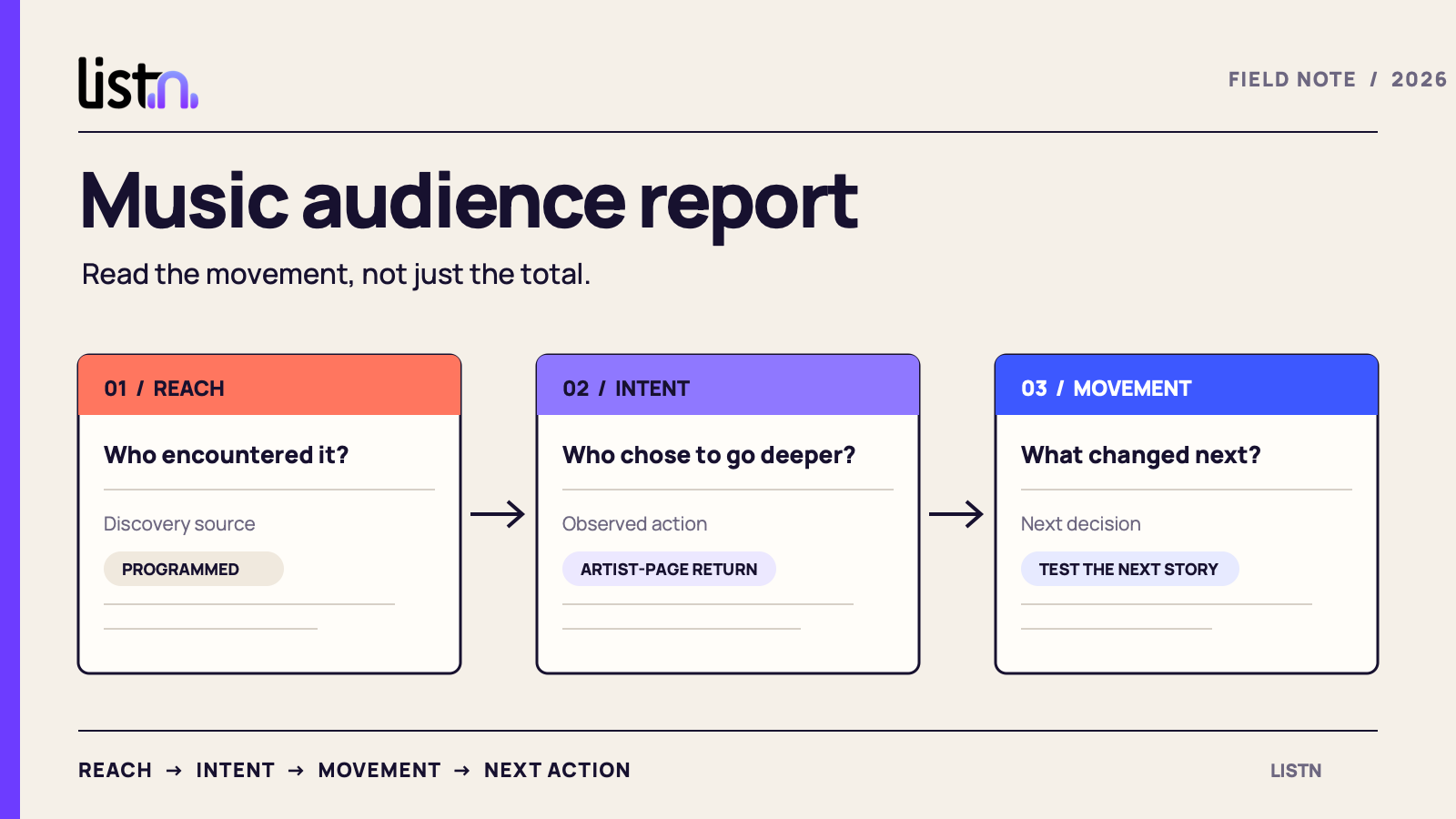
A useful music audience report should do more than restate monthly listeners, views or impressions. It should show how people discovered the release, which actions revealed intent and what changed after the campaign. That three-part view — reach, intent and movement — gives labels and independent artists a practical way to turn release data into the next decision.
The goal is not to produce a larger dashboard. It is to make one decision easier: what should the team keep, stop, change or test on the next release?
Why one audience number is not enough
A headline audience total answers a reach question: how many people encountered the artist during a period? It does not explain whether those people arrived through passive programming, intentionally chose the artist, returned later or moved towards a stronger relationship.
Spotify for Artists makes that distinction explicit in its audience segments guide. Its Segments view separates monthly active, previously active and programmed listeners, and shows how those groups change over time. The categories are platform-specific, but the reporting lesson is broader: audience size and audience behaviour are different measures.
Two releases can therefore produce similar reach and require different follow-up. One may attract wide programmed discovery with little intentional return. Another may reach fewer people but bring more listeners back to the artist profile, catalogue or next piece of content. Reporting only the total hides that difference.
Build the report around three questions
1. Reach: who encountered the release?
Start with the discovery layer. Record where attention came from and keep unlike sources separate. Editorial or algorithmic programming, creator content, paid social, radio support, direct fan communication and the artist’s own posts do not create the same context.
Use the reach section to describe exposure, not to claim conversion. Useful fields include discovery source, market, content format, campaign window and the audience definition used by the platform. If a platform reports estimates, label them as estimates rather than mixing them with verified actions.
2. Intent: who chose to go deeper?
Intent signals are actions that require a listener or viewer to make another choice. The right signal depends on the objective and the platform, so avoid forcing every release into one universal score.
- For streaming: intentional artist-page or release-page listening, saves, follows, playlist adds and repeat listening where available.
- For video: returning viewers, related-video clicks, meaningful comments, channel visits and continued viewing.
- For owned destinations: verified landing-page visits, email sign-ups, ticket actions or purchases when those are the campaign objective.
A signal is useful only when the team can connect it to a decision. A save may support a retention hypothesis; a repeated question in comments may reveal missing context; a profile return may justify a deeper artist story. Do not combine these actions into a single “engagement” total before understanding what each one means.
3. Movement: what changed after the campaign?
Movement compares the audience relationship before and after the release window. The comparison should be within the same artist and a consistent measurement frame, not between artists with different histories, markets and campaign conditions.
For example, a team can track whether programmed discovery was followed by more intentional artist-page listening, whether previously active listeners returned, or whether a video brought people back for a second piece of content. The report should state the observed change and the next action separately. That prevents a correlation from being presented as proof that one channel caused the result.
If you need a refresher on the underlying Spotify categories, use the Spotify audience segments guide.
For campaign timing, the D+3, D+7 and D+14 checkpoints in the post-release music campaign review help keep the comparison consistent.
Use a simple release-review table
A compact report can use one row per meaningful source or audience path. The essential columns are:
- Discovery source: where the person first encountered the release.
- Reach measure: the exposure metric available for that source.
- Intent signal: the next deliberate action you can observe.
- Movement: the change against the agreed pre-release baseline or previous checkpoint.
- Next action: keep, stop, change or test.
- Confidence note: what the data can and cannot establish.
One example might read: programmed discovery → artist-page return → test a clearer artist story in the next asset. Another might read: repeated production questions in comments → behind-the-scenes Short → review returning viewers and related-video clicks. The report remains useful because each observation ends with a testable action.
Turn comments into the next creative brief
Audience movement is not only a streaming question. Comments can reveal curiosity, confusion, recognition and willingness to participate. Treating them as a qualitative input gives the team a response lane alongside the planned content calendar.
Use a four-step response loop:
- Capture repeated questions, phrases and reactions without rewriting them into the team’s language.
- Classify the response by intent: curiosity, confusion, recognition or participation.
- Choose one appropriate format: a reply, Short, behind-the-scenes clip, related video or a clearer explanation.
- Publish the response and review whether it brought people back or prompted a more useful next action.
This approach aligns with YouTube for Artists’ post-release guidance, which recommends continued supporting visuals, Shorts, comment engagement, related videos and ongoing performance review after release day.
The point is not to chase every comment. Repetition matters. A single reaction may be anecdotal; a recurring question can become a strong creative hypothesis.
Make the next decision before closing the report
A release report is finished only when it changes the next brief. End with one primary decision and no more than a few supporting tests. Keep what produced the intended behaviour, stop what clearly failed its delivery or relevance test, change the message when the audience response reveals confusion, and scale only when the signal remains useful beyond raw reach.
For a multi-release team, preserve the same reach–intent–movement structure across campaigns. That consistency makes patterns easier to spot without reducing different artists to one benchmark.
LISTN can support the next targeting decision with matched radio and creator shortlists. Build the next campaign shortlist in LISTN, then use the following release report to decide what deserves another test.