
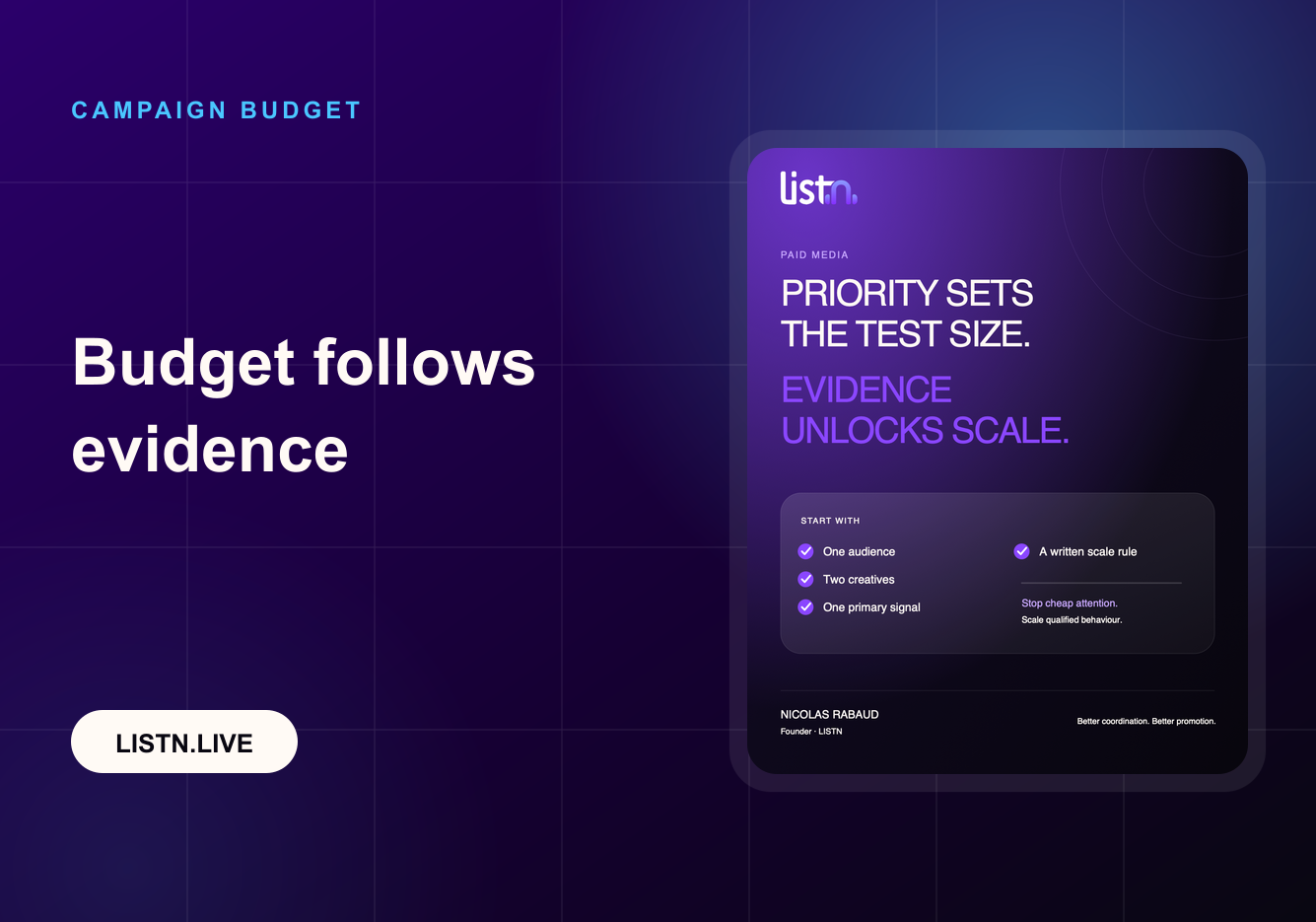
Every campaign reaches a moment when internal pressure wants to override the evidence. A release feels important, the artist has expectations, and the deadline is approaching. Without a written budget structure and a clear scale rule, teams tend to make spending decisions based on how a release feels rather than what it shows.
This guide explains how to build a music promotion budget around a focused test, decide what evidence matters, and define when to keep, stop or scale before the results arrive. It is not a universal spending prescription: available cash, audience maturity, release goals and channel costs vary too widely for one number to fit every campaign.
If you already have a release brief, you can pitch your track to LISTN and compare playlist, radio and creator promotion options while you build the test below.
Start with the decision, not the total
Before choosing a budget, write the decision the campaign must support. For example: “Which audience and creative combination produces qualified listener behaviour that is worth repeating?” That question is more useful than “How much reach can we buy?” because reach is an input, not evidence that listeners care.
Choose one primary signal that reflects the campaign goal. It might be saves, repeat listening, follows, meaningful profile actions or another behaviour you can measure consistently. Supporting metrics can help diagnose performance, but they should not all compete for equal weight.
The music marketing plan template can help you document the audience, goal, primary signal and scale rule before spend is released. If you are still choosing support, use the music promotion services guide for 2026 to compare service types and the questions to ask providers.
Size a readable test
A common mistake is spreading a limited budget across too many channels. If five channels each receive too little activity to produce a readable signal, the result is five inconclusive answers rather than one useful one.
A focused test usually contains:
- one defined audience;
- one channel or promotion method;
- two creative executions that test a meaningful difference;
- one primary success signal;
- a fixed review window; and
- a pre-agreed maximum loss the campaign can absorb without disrupting the rest of the release plan.
Your test amount should be the smallest practical amount that can give those inputs a fair comparison under the conditions of the chosen channel. Ask the platform or provider what minimum activity is needed to evaluate the test, then check that amount against your cash constraints. If the answer exceeds the amount you can responsibly risk, narrow the test or choose a different method; do not stretch the campaign simply to meet an arbitrary benchmark.
Use this budget decision worksheet
Complete the worksheet before launch. The amounts and thresholds are campaign-specific; any example you add is an assumption to test, not a promise of results.
| Decision field | What to write | Example assumption |
|---|---|---|
| Campaign objective | The listener behaviour the release should create | “Increase qualified discovery for the single” |
| Audience | One specific listener segment | “Listeners of adjacent artists in two priority markets” |
| Test design | Channel, two creatives and review window | “Creator promotion; performance clip vs story-led clip; review after the agreed window” |
| Primary signal | One behaviour that determines the decision | “Cost per save among reached listeners” |
| Budget ceiling | Maximum amount available for the test | “No more than the approved test allocation” |
| Keep rule | Evidence that justifies maintaining the test | “Primary signal is consistent and within our assumed acceptable range” |
| Stop rule | Evidence that ends this version of the test | “Attention does not lead to the defined listener behaviour” |
| Scale rule | Evidence and increment required to release more budget | “Signal holds across the review window; increase in a controlled step” |
| Learning note | What will change in the next test | “Keep the audience, replace the weaker creative” |
The example column deliberately avoids universal currency amounts. A self-funded artist and a label running several releases may use the same decision structure while operating with very different ceilings.
Write keep, stop and scale rules before launch
A scale rule is a written decision made before the campaign starts. It defines the conditions under which additional budget will be released, maintained or withdrawn. Writing it early protects the team from scaling on enthusiasm or stopping because of one early result.
Use three positions:
- Keep: Continue the audience and creative combination at its current level while the primary signal remains credible.
- Stop: Pause a combination that generates attention but not the qualifying behaviour, or that breaches the agreed budget ceiling.
- Scale: Release the next controlled increment only when the signal remains stable across the full review window and there is enough operational capacity to support it.
Avoid turning “scale” into an unlimited commitment. Name the next increment, the next review point and the condition that would stop further spend. That makes each increase another test rather than a leap of faith.
Separate audience, creative and channel
When results disappoint, do not change every variable at once. Separate the three main components:
- Audience: Did the promotion reach people with a credible reason to care about this release?
- Creative: Did the message and asset give them enough context to act?
- Channel: Could the format and placement produce the listener behaviour you selected?
Change one component, preserve the others, and run the next comparison. This makes the result reusable. Replacing the audience, creative and channel simultaneously may improve performance, but it will not tell you why.
Channel inputs are not interchangeable outcomes. A playlist add, creator post or radio spin is an activity; the listener behaviour it generates is the result. The radio vs playlist vs creator promotion guide explains what each channel can test and how to compare the evidence. For platform-specific planning, see the Spotify promotion guide and Spotify playlist submission guide.
When the test produces no clear signal
An inconclusive result usually means the audience was too broad, the creative difference was too small, the review window was poorly chosen, or the primary signal was not measurable enough. It does not automatically mean the track failed.
Return to the worksheet and ask:
- Did both creative versions receive a fair opportunity within the same conditions?
- Was the primary signal available and recorded consistently?
- Did an external event distort the review window?
- Can one variable be tightened without increasing the budget ceiling?
If the answer is no, stop and redesign. Spending more on an unreadable setup rarely makes the conclusion clearer.
Build a budget record across releases
A single campaign gives you a result. A consistent record gives you a planning asset. After each release, save the test inputs, spend, primary signal, decision, and what changed next. Over time, this creates evidence for future ceilings and helps distinguish repeatable patterns from one-off outcomes.
For labels and teams handling several artists, the same structure also makes reporting legible across the roster. Each campaign contributes a comparable decision record instead of a disconnected list of activities.
Ready to turn the worksheet into a focused campaign? Submit your track to LISTN to explore playlist, radio and creator promotion for your next release.
Frequently asked questions
How much should I spend on music promotion?
There is no universal figure. Start with the smallest responsible amount that gives one audience, one channel and two creative executions a fair chance to produce a readable primary signal. Set the ceiling from your available cash and release priorities, not from pressure to match another artist’s budget. Treat any sample amount from a platform, provider or case study as an assumption until it is validated against your campaign.
What is a music promotion scale rule?
A scale rule is a written decision, made before the campaign starts, that defines the conditions under which additional budget will be released, maintained or withdrawn. Its purpose is to protect the team from scaling on internal pressure or stopping on one early number before the signal has had time to stabilise.