
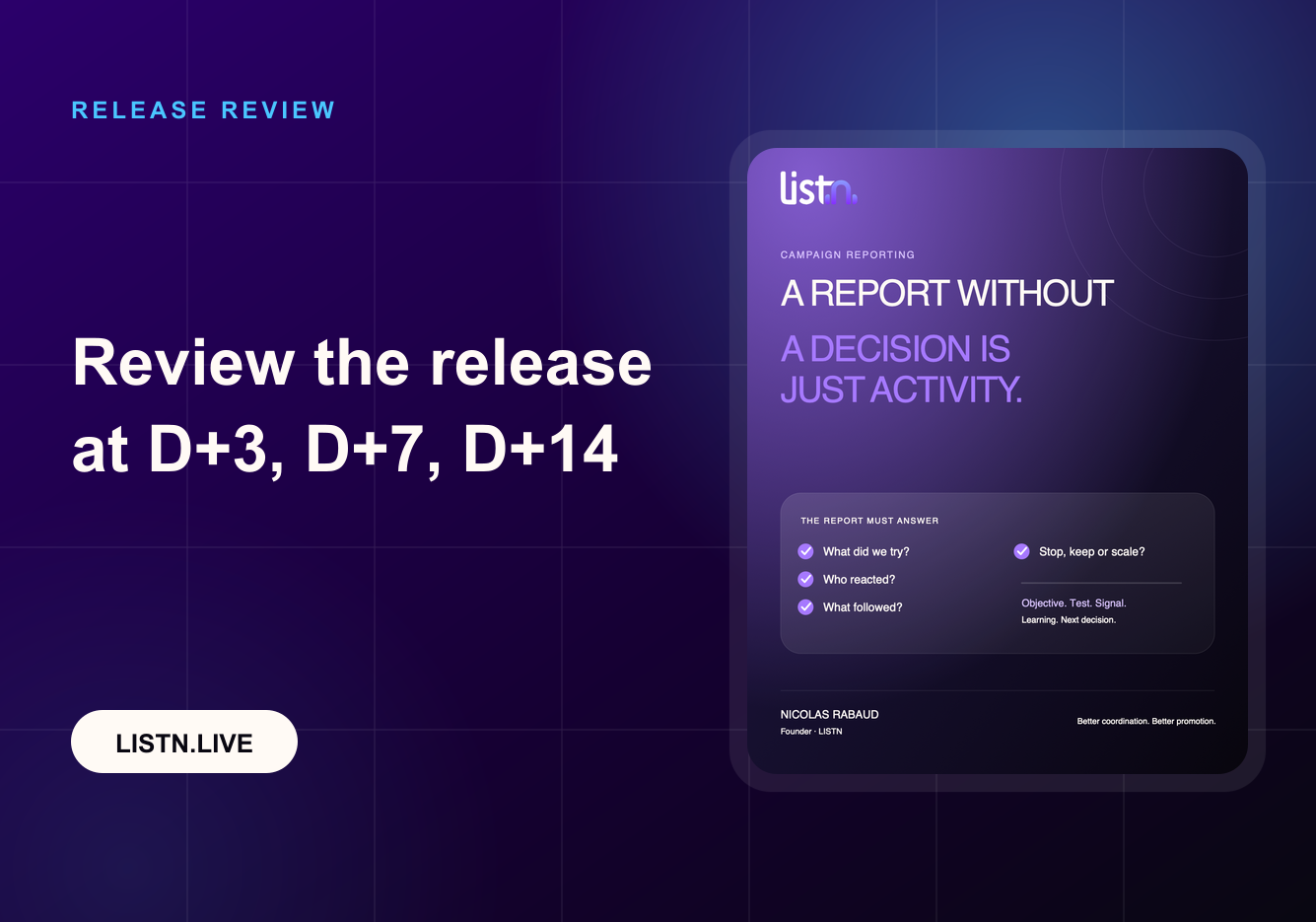
Most campaigns fail to generate learning not because the channel was wrong, but because nobody scheduled a decision before the results arrived. Without structured review points, a campaign ends with data and no clear action. The D+3, D+7 and D+14 framework gives labels and independent artists a scheduled moment to check delivery quality, read audience signals and make a confirmed keep, stop or scale decision while the campaign is still running.
This guide explains what to review at each checkpoint, which signals to prioritize, how to keep the report readable enough to act on, and the most common post-release mistakes to avoid.
Why review timing determines campaign value
A campaign review scheduled only after the campaign is over can describe what happened but cannot change it. The value of structured review points is not that they generate more data. It is that they preserve the opportunity to act on evidence while something can still be adjusted.
Most early campaign data is noisy. Launch week creates a natural spike from existing followers, newsletter links, social sharing and press coverage that normalizes quickly. D+7 and D+14 exist partly to read past that spike and identify which behavior persists independently of the launch effect.
Scheduling three checkpoints before the campaign also protects the team from pressure to scale too early or stop on one disappointing number. Defining the decision rule before launch — not after results arrive — is the single most reliable safeguard. The music campaign brief template has a dedicated section for writing that rule before the campaign starts.
D+3 — Confirm delivery and baseline quality
The first review has one job: confirm that every channel delivered correctly and that early technical quality is acceptable. This is not a performance review. The streaming data is too early to be interpretable.
Check at D+3:
- Public links are live and point to the correct recording and artist profile.
- Metadata, credits and artwork appear correctly on streaming platforms.
- Campaign destinations are active and connected to the right recording.
- No content claims, rights conflicts or distributor delivery errors.
- First streaming signals are plausible given the release scope and audience size.
D+3 is the window for fixing delivery problems before they affect the campaign. After D+7, most platform delivery issues become significantly harder to reverse.
D+7 — Read audience and channel signals
By D+7, the post-launch spike has partially normalized and the first campaign-generated behavior is visible. This review focuses on which audience and channel combination is producing the most qualified response.
Three streaming signals to prioritize
A save suggests the listener wants future access to the track. A repeat stream suggests the track held attention after the initial discovery. A playlist add suggests the listener chose to place the song inside their own listening context.
Read these three signals together rather than separately. A high save rate with low repeat listening may mean the track creates anticipation but does not match the listener's expectation. A high repeat rate from a narrow audience may reveal a specific scene or format where the track performs well.
Also review at D+7:
- Artist follows generated during the campaign window.
- For creator content: sound-page opens, profile visits and link clicks from short-form platforms.
- The ratio of programmed to active streaming where available in Spotify for Artists.
- Whether the primary audience defined in the brief matches the actual listening audience.
For a practical introduction to the three audience types — active, previously active and programmed — see the Spotify audience segments guide.
Record the D+7 signal before the D+14 meeting. The goal is not a final judgment. It is a documented snapshot that the D+14 decision can reference directly.
D+14 — Keep, stop or scale
D+14 is the campaign decision point. One question drives the review: what has this campaign taught us about this release and this audience, and what should change next?
Three outcomes are available:
Keep
The audience and channel combination is producing relevant qualified behavior. The listener signal is consistent with the release objective. Continue at the current level while the signal remains.
Stop
The campaign is producing attention without the intended behavior. Views or impressions are acceptable but saves, repeats and playlist adds are not following. Reallocate budget to a different audience, channel or creative combination.
Scale
The listener signal remains strong as volume increases and the cost per qualified action is still acceptable. Scale only when the evidence supports the hypothesis, not because the release feels important or the deadline is approaching.
Write the keep, stop or scale criteria before the campaign launches. Internal pressure is strongest around priority releases. A prewritten decision rule protects the team from scaling on intuition or stopping based on a single early number.
Make every review report readable
If a campaign report needs a guided tour, it is not ready to drive a decision. The first screen of a D+7 or D+14 report should answer four questions without scrolling:
- What was the objective?
- What happened?
- What did it cost?
- What happens next?
Supporting detail can exist below that hierarchy, but the headline result, primary signal, cost and learning should be immediately visible. A report that places every metric at equal visual weight effectively tells the reader that nothing is the priority.
A practical report structure:
- Headline result — one sentence describing the primary finding.
- Qualified signal — the behavior that confirms or questions the hypothesis.
- Cost per qualified action — the number that connects spend to outcome.
- Learning — one sentence the team did not know before the campaign.
- Next action — owner and date.
For label rosters, a consistently readable report has operational value beyond the current release. Every D+14 review generates evidence about which audience, creative, channel and territory produced a qualified response. That evidence builds the brief for the next release.
Build the review schedule before launch
Create the three checkpoints before the campaign starts:
- Assign a review owner for D+3, D+7 and D+14.
- Add calendar events for each checkpoint at launch, not after results arrive.
- Define the primary signal at D+7 in the campaign brief so the team is not inventing it at the meeting.
- Write the keep, stop or scale rule so it exists before results arrive.
One person may own all three reviews on a small team. The important constraint is that the dates and the decision rule are documented before the campaign starts. This connects naturally to the delivery and pitch preparation covered in the music release planning checklist.
Common post-release review mistakes
- Starting the review with no documented baseline from before the campaign.
- Changing the primary signal after results arrive to find a metric that looks better.
- Treating view counts as equivalents of listening intent.
- Reviewing too early and optimizing on launch-spike noise rather than persistent behavior.
- Waiting until D+30 when only a small budget adjustment could still change the outcome.
- Reporting every metric with equal visual weight so the decision has no clear input.
- Scheduling the review only after a result looks interesting, which tends to confirm what the team already believed.
When you are ready to build the campaign that will be reviewed, explore LISTN playlist, radio and creator workflows and compare the channels available for your release.